
ReSound Sensia Hearing Aids: How the Four Tech Levels Differ
September 20, 2026 | Dr. Jade Husby, Au.D.
Short Version
- ReSound Sensia comes in four tech levels, 9, 7, 5 and 4, and the level sets how finely the device separates a voice from the room.
- Every level shares four programs, an IP68 build and Auracast streaming.
- Match the ReSound Sensia level to your hardest listening room, then let your provider match the receiver to your hearing.
Most people who call us about ReSound Sensia open with the same worry, which is that the ReSound hearing aids they spent three weeks researching are now the wrong ones. They are not. Sensia sits alongside Vivia and Nexia, we still sell all three, and the real question was never which line is current, it is which line suits the way you listen. Underneath that, what almost everyone is asking is what separates the four tech levels and whether the top one is worth the difference.

What ReSound Sensia Is, and Where It Sits Beside Vivia and Nexia
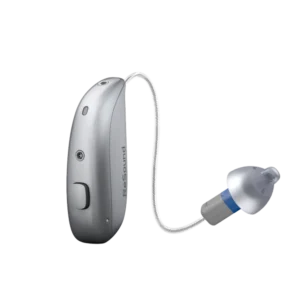
ReSound Sensia is a family of receiver-in-ear hearing aids built around automatic noise handling, and it is one of three ReSound lines on our shelf rather than a swap for the other two. We still sell both Vivia and Nexia, and both still fit beautifully for the right person, which is why we kept our comparison of ReSound Vivia and ReSound Nexia exactly as it was. Sensia gives us a fourth and a fifth price point to work with inside ReSound, and that matters more to a real budget than any single feature does.
What a Receiver-in-Ear Design Means
A receiver-in-ear design keeps the working parts behind your ear and runs a thin wire to a small speaker sitting in the canal. The National Institute on Deafness and Other Communication Disorders describes the open-fit version of this approach as fitting behind the ear completely, “with only a narrow tube inserted into the ear canal, enabling the canal to remain open,” which is why so many people find their own voice sounds normal in one. Sensia uses that shape across the line.
What you get at every tech level:
- Four fully flexible programs, the same count from level 4 to level 9, so nobody loses program capacity by choosing a lower level.
- An IP68 rating against dust and moisture, which covers a sweaty afternoon in the garden and a walk home in the rain.
- Bluetooth streaming to compatible iPhone and Android devices, plus Auracast.
- The ReSound Smart 3D app for volume, programs and remote adjustments.
- Remote fine tuning through ReSound Assist and ReSound Assist Live, so a small change does not always mean a drive into town.
The shared list is longer than the differences list, and that is the honest headline of this whole line.
The Four ReSound Sensia Tech Levels, and What Changes Between Them
Tech level changes how finely the hearing aid can slice the sound coming in, and how many independent decisions it makes inside a noisy room. Everything else stays put. A level 4 and a level 9 charge the same way, stream the same way and survive the same rainstorm, so the money you move between them buys processing and nothing else.
How Channels Change What You Hear
The part worth understanding rather than memorizing is what a channel does. Sound arrives at the microphone as one mixed signal, and the hearing aid splits it into channels so it can treat different frequency regions differently. With 12 channels the device works in fairly wide bands, so lifting the frequencies where a voice lives also lifts some of the clatter sitting in the same band. At 17 channels those bands are narrower, and the device can raise a slice where speech sits while leaving the slice next door alone. That is the whole mechanism, and it is why the top level earns its keep in a restaurant and barely shows itself in a quiet kitchen.
| Sensia level | Processing channels | Noise Tracker II settings | Intelligent Noise Tracker | App sound adjustment |
| Sensia 9 | 17 | 5 | 3 settings | Sound Enhancer included |
| Sensia 7 | 14 | 4 | On or off | Not included |
| Sensia 5 | 12 | 3 | Not available | Not included |
| Sensia 4 | 12 | 2 | Not available | Not included |
Every figure in that table comes from the standard receiver technical datasheet for the line. Reading down the noise column tells you the real story: the steps are even, they are small, and they stack. Our guide to choosing a hearing aid technology level walks through the same decision across the other brands we carry.
Which ReSound Sensia Level Is Best If You
There is no single best hearing aid, only the one that is best for you, and with this line the answer falls out of where you spend your difficult hours rather than out of your audiogram alone.
- Best if you eat out often, work in meetings or sit in a busy church. Sensia 9 gives you 17 channels, five Noise Tracker II settings and Sound Enhancer in the app, which is the widest set of tools for a room full of competing voices.
- Best if you want strong noise handling without the top price. Sensia 7 keeps 14 channels and four Noise Tracker II settings, which is the widest noise handling available below the top level.
- Best if your hard listening is occasional. Sensia 5 runs 12 channels with three noise settings, which handles a family dinner well and asks less of your budget.
- Best if you are mostly one-to-one and at home. Sensia 4 shares the channel count of level 5 with two noise settings, and it still streams, still charges and still connects to the app.
- Best if cost is the deciding factor. The lower levels give up processing, never programs, durability or connectivity, so the compromise is narrower than most people expect.
Nobody should pick a level from a chart alone, and we do not ask anyone to. We run these numbers against your own hearing, in a room with sound in it, before anyone commits to a level.
Battery, Charging and Everyday Wear
Rechargeable Sensia models run 30 hours on a charge with no streaming, and 24 hours on a typical day that already includes several hours of streaming. That second figure is the one to plan around, because it is the one measured against real use. A day that starts at six in the morning and ends at ten at night is 16 hours, so there is genuine headroom in a 24-hour figure, and that headroom is what keeps a long wedding or a late flight from turning into a problem.
Rechargeable or a Battery Door
The line also comes in two battery-door versions for people who would rather carry spares than find an outlet. Those use size 312 and size 13 batteries, and the size 13 model is the only one in the family with a telecoil, which matters enough to have its own section below.
What the battery decision usually comes down to:
- Rechargeable, the 60S models. Drop them in the charger overnight, no small doors, no fiddly cells, and a 24-hour typical figure that covers a long day with room left over.
- Size 312, the 61 models. A smaller body than the size 13, and a push button for control.
- Size 13, the 62 models. The largest cell in the family, a multi-function button, and the only telecoil option in the family.
- Dexterity is the real tiebreaker. If changing a watch battery is a struggle, rechargeable wins before any spec does.
- Every version is rated IP68, so the moisture question does not steer this choice.
We go through this with a charger and a live device on the table, because the decision gets easier the moment you hold both. Our guide to making the switch to rechargeable hearing aids covers the habits that make a rechargeable pair work.

Streaming, Auracast and the Telecoil Question
Every ReSound Sensia streams directly from compatible iPhone and Android devices, and every level in the family supports Auracast. Auracast is the newer broadcast standard that lets a venue send audio straight to your hearing aids, and the Bluetooth Special Interest Group, which publishes the Auracast broadcast audio standard, is the group defining how those broadcasts work. Airports, theaters and waiting rooms are the early venues, and adoption is uneven by design while the rollout continues.
Loop or Auracast, and How to Choose
One trade-off never makes it onto a brochure. A telecoil picks up the magnetic signal from a hearing loop, and loops are already installed in a great many churches, theaters and civic buildings around us. In this family, the telecoil lives only on the size 13 battery model. Choosing a rechargeable model means choosing Auracast without a telecoil, and if your Thursday night depends on a loop that is already in the ceiling of a building you have attended for thirty years, that is not a small thing.
How we talk it through:
- Loop first. If the rooms you care about already have a loop, the size 13 model with its telecoil is the straightforward answer.
- Auracast first. If your hard rooms are newer venues or you stream constantly from a phone, a rechargeable model serves you better.
- Both matter. We check which local venues you attend in a normal month before anyone commits, since the answer is specific to your week.
- Ask about the venue, not the technology. Staff at a theater can usually tell you what runs in the room, and we will help you ask.
More on this sits in our explainer on why telecoils matter in modern hearing solutions and on why Auracast is the future of hearing aid connectivity.
Receivers, M&RIE, CROS and Bimodal Options
We fit this line by receiver rather than by a single one-size specification, and the receiver is the small speaker that sits in your canal. The standard receiver comes in four strengths, LP, MP, HP and UP, and your provider selects one against your audiogram rather than against a category label. That is the part a spec sheet cannot answer for you, because two people with the same word on their chart can need different receivers.
M&RIE, CROS and Bimodal Fittings
| Receiver option | Who it suits | What to know |
| Standard, LP to UP | Most wearers | Four strengths, selected against your audiogram |
| M&RIE | Wearers who care about direction | Adds a microphone inside the ear itself |
| CROS transmitter | One ear that cannot use amplification | About 16 hours per charge in a CROS or BiCROS fitting |
| Bimodal, levels 9 and 5 | Cochlear Nucleus processor users | Rechargeable and M&RIE only, no hands-free calling |
Three variations sit inside the same family:
- M&RIE. A receiver with a microphone in the ear itself, which collects sound at the spot your own ear shape has already worked on. People who care about knowing where a sound came from tend to notice this one.
- CROS. A transmitter worn on an ear that cannot use amplification, sending sound across to the hearing aid on your better side. It runs about 16 hours in a CROS or BiCROS fitting and charges the same way the hearing aids do. Our post on understanding CROS hearing aids explains who this suits.
- Bimodal. Dedicated models made to work with a Cochlear Nucleus sound processor, available in the level 9 and level 5 tiers, rechargeable, with the M&RIE receiver. Hands-free calling is not available once a device is linked in a bimodal fitting, and an Auracast broadcast reaches one ear rather than two.
Receiver selection happens in the fitting chair, and it is one of the reasons we ask you to come in before you settle on anything. We keep the strengths on hand so nobody goes home wearing a best guess.
How We Fit ReSound Sensia in Sioux Falls and Buffalo
Buying the right tech level and wearing a hearing aid that hits its targets are two different achievements, and the second one is the one that changes your dinner conversations. When we program a pair of hearing aids, we do not stop at the manufacturer’s first-fit settings, because those are calculated from your audiogram and an average ear canal. Your canal is not average. It has its own length, its own shape and its own resonance, so the same programming produces a different sound in your ear than it does in the software.
Why Real Ear Measurement Changes the Result
Real ear measurement solves that. We place a soft probe microphone in your canal alongside the hearing aid, play calibrated speech through it and read what is happening at your eardrum rather than what the screen predicted. Then we adjust until the measured output matches the target for your hearing loss. The difference is usually audible in the room on the same afternoon, and it is why two clinics fitting the identical device can send two patients home hearing differently.
What the fitting appointment covers:
- A full check of your hearing first, since no device gets programmed off an old test.
- Receiver selection, matching LP, MP, HP, UP or M&RIE to your results rather than to a label.
- Real ear measurement, verifying the output at your eardrum against target.
- App setup and streaming, paired to your own phone before you leave.
- Follow-up adjustments, in person or through remote care, over the weeks your brain is still adapting.
NIDCD puts the adaptation plainly: “Hearing aids take time and patience to use successfully. Wearing your aids regularly will help you adjust to them.” We plan for that rather than hoping around it. You can read more about our approach to live speech mapping, and about scheduling a hearing test if it has been a few years.
Why Choose Stanford Hearing, and What to Do Next
We have been locally owned in Sioux Falls for 20-plus years, and voted Sioux Falls Local Best 20 years, which means most of the people reading this have a neighbor who has sat in our chair. Come see whether this line is right for you, at our Sioux Falls hearing center or our Buffalo hearing center in Minnesota.
What Comes With Every Fitting Here
- Free consultations with no pressure to buy. Your first appointment is a complimentary assessment of your hearing and your needs, with no obligation.
- Five premium brands, Phonak, ReSound, Starkey, Unitron and Oticon, recommended against your hearing and your life rather than against a supplier agreement.
- Options for every budget, which is exactly why a four-level line like this one is useful to us.
- A 10-day trial so you can buy with confidence. Wear your hearing aids in your real life, at home, at work, and out with people, before you decide. If they are not right for you, return them inside your trial window for a full refund.
- A price match guarantee means you will not overpay locally. If a nearby clinic beats our price on a comparable device, we meet it. Bring us what another local clinic quoted you and we will take a look.
- 12 months no-interest financing spreads the cost into monthly payments, for qualifying patients and subject to credit approval.
- In-network with all major insurance providers, including Medicare Advantage. Original Medicare does not cover hearing aids, many Medicare Advantage plans include a hearing benefit, and we verify your benefits before your appointment so you know what is covered before you commit.
- Unlocked devices and hands-on service, from testing to fitting to follow-up adjustments, with remote care available between visits.
- Your hearing aids come with the manufacturer’s warranty, including the manufacturer’s loss and damage coverage. Terms vary by brand and model.
Booking Your Visit
Whether you land on a level 9 for restaurants or a level 4 for a quiet house, the next move is the same. Schedule a free consultation and we will test your hearing, talk through what you are missing and let you hear the difference for yourself.
Common Questions About ReSound Sensia
Does Stanford Hearing carry every ReSound Sensia tech level?
We fit ReSound Sensia across all four levels, 9, 7, 5 and 4, because a four-level line lets us match a device to a budget without dropping someone to a different brand. Our providers will tell you plainly when a lower level will serve you just as well, which happens more often than people expect.
How long do I have to decide if ReSound Sensia is right for me?
Ten days. Every purchase from Stanford Hearing includes a 10-day trial, so you wear the hearing aids at home, at work and out with people before you decide, and if they are not right for you, return them inside your trial window for a full refund. We would rather you find that out in your own kitchen than in ours.
Is Sensia a good choice if I already wear ReSound hearing aids?
Often, and not automatically. Stanford Hearing will compare what you wear now against what Sensia changes for your particular rooms, and sometimes the honest answer is that your current pair needs a retune rather than a replacement. We will say so.
What happens if Sensia is not the right fit for my hearing?
Then we move on. Stanford Hearing carries Phonak, ReSound, Starkey, Unitron and Oticon, so a poor match with one line simply sends us to the next, and your test results travel with you rather than starting over.
Can Stanford Hearing adjust ReSound Sensia without me driving in?
Often, yes. Sensia supports remote fine tuning through ReSound Assist and ReSound Assist Live, so our providers can send a small programming change to your hearing aids between visits. Bigger changes still want a chair and a probe microphone, and we will tell you which one you are dealing with.
A Note on Hearing Care and Medical Advice
This content is for informational purposes and is not a substitute for medical advice, diagnosis, or treatment. If you notice a sudden change in your hearing, see a licensed medical professional. Hearing aid results vary by individual and by hearing profile.