
Understand CROS Hearing Aids
Updated June 2026
When one ear hears well and the other does not, CROS hearing aids may help. These systems route sound from your weaker side to your better ear. You stop missing half the conversation, and daily life feels balanced again. CROS hearing aids do not fix the weaker ear. They restore your awareness of both sides.
This guide explains how CROS systems work and who they help. It also covers BiCROS systems, causes, and how a fitting works locally. The right path starts with a diagnostic hearing evaluation to map both ears.
What Is a CROS Hearing Aid?
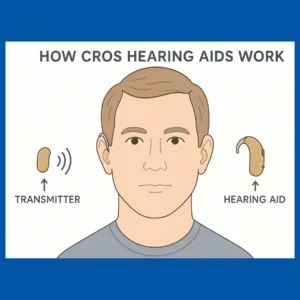
CROS stands for Contralateral Routing of Signals. The system supports people with no usable hearing in one ear. Its goal is simple. You should not miss sounds that arrive on your weaker side. Here is how a CROS setup works:
- A transmitter sits on your non-hearing ear
- A receiver sits on your better-hearing ear
- Sound from the poor side streams wirelessly to the good side
CROS systems do not amplify the non-hearing ear. Instead, they give your working ear access to sound from both directions. That creates a fuller, more balanced sound picture. The device on your good ear looks like an ordinary hearing aid. Modern systems are discreet and often rechargeable. You keep full use of your better ear at all times. Everyday communication gets noticeably easier.
What Is a BiCROS Hearing Aid?
A BiCROS system helps when both ears have loss, but one side is far worse. BiCROS stands for Bilateral Contralateral Routing of Signals. It combines signal routing with real amplification. Here is what sets it apart:
- The poorer ear wears a transmitter
- The better ear wears a receiver with a working hearing aid
- The system routes sound from the bad side and amplifies the good side
BiCROS suits people who need different levels of help in each ear. A good example is moderate loss on one side and severe loss on the other. For molded styles and comfort options, see our guide to custom hearing aids. Your hearing care provider will confirm which setup fits you. The transmitter looks just like the hearing aid on your better ear. Most people cannot tell the two apart.
CROS vs BiCROS vs a Single Hearing Aid
Choosing the right system depends on how each ear performs. This table lines up the common scenarios. Use it as a starting point, not a diagnosis.
| Your Hearing | Best Option | Why |
|---|---|---|
| One ear deaf, other ear normal | CROS system | Routes sound to the good ear, no amplification needed there |
| One ear deaf, other ear has some loss | BiCROS system | Routes sound and also amplifies the better ear |
| Both ears with similar loss | Two standard hearing aids | Each ear still benefits from amplification |
| Mild loss in one ear only | One standard hearing aid | The weaker ear can still use gain |
The pattern is clear. When the poor ear cannot use amplification, routing sound is the smarter move.
Why CROS Hearing Aids Matter for Single-Sided Deafness
Hearing with one ear creates real problems, especially in noise. You may turn your head constantly or miss speech on your weak side. The biggest culprit is the head shadow effect. Your own head blocks high-frequency sound from reaching the good ear. Those blocked sounds include consonants, which carry most speech meaning. Here is what single-sided deafness makes harder:
- Following conversation in restaurants or meetings
- Knowing which direction a sound came from
- Hearing someone seated on your weaker side
- Staying relaxed instead of straining all day
Straining to hear on one side wears you down over time. That effort quietly drains your focus and energy. CROS systems route sound around the head to the working ear. That restores access to both sides and eases the daily strain.
Benefits of CROS and BiCROS Hearing Aids
These systems will not restore the weaker ear. Even so, they change how you experience sound each day. The gains show up quickly for most wearers. Here are the benefits patients notice most:
- Clearer speech understanding in noisy rooms
- Fuller awareness of traffic, voices, and surroundings
- Better balance in conversation without turning your head
- Less listening fatigue during long days
By sending sound to your stronger ear, these systems lower daily strain. That steady relief is what keeps people wearing them. Confidence in conversation often returns within the first week.
What Causes Single-Sided Deafness?
Single-sided deafness has many possible triggers. Knowing the cause guides the right care. Common causes include:
- Sudden sensorineural hearing loss with no clear reason
- Acoustic neuroma, a benign nerve tumor
- Ménière’s disease affecting one ear
- Head trauma or inner ear injury
- Serious infections
- Age-related decline that hits one side harder
Sudden loss deserves urgent attention. The NIDCD notes that sudden hearing loss is a medical emergency and needs prompt care. If your hearing drops fast in one ear, see a doctor right away. For more myths and facts, read our guide to sudden hearing loss. Early treatment can protect the hearing you have. Whatever the cause, a full evaluation points you toward the right solution.

Why Not Just Amplify the Weaker Ear?
Turning up the volume on a dead ear often backfires. In many cases it creates new problems instead of clarity. Here is why amplification alone can fail:
- Rollover loss means speech gets worse as volume rises
- Dead regions of the cochlea no longer respond to sound
- Recruitment makes loud sounds feel painfully loud fast
- Distortion turns amplified sound fuzzy and unnatural
- Cross-hearing lets leaked sound confuse the good ear
CROS and BiCROS systems sidestep these issues. They protect clarity in the good ear while restoring awareness from the poor side.
Alternatives to CROS and BiCROS
CROS is not the only path for single-sided deafness. Other options exist, though some involve surgery. Here are the main alternatives:
- Bone-anchored devices, which send sound through the skull
- Cochlear implants, used in specific cases of profound loss
- Communication strategies like seating choices and lip reading
Each option has trade-offs in cost, comfort, and recovery. A hearing care provider can walk you through the pros and cons. CROS and BiCROS deliver strong benefits without any surgery. For many people with single-sided deafness, that makes them the easiest first step.
The Brands We Fit for CROS and BiCROS
We fit CROS and BiCROS systems from the premium brands we carry. That means your transmitter matches a hearing aid you already trust. Here are three popular options we work with:
| Brand | CROS or BiCROS Option | Notable For |
|---|---|---|
| Phonak | CROS Infinio | Pairs with the Audeo Infinio platform |
| ReSound | Vivia CROS | Works with the microRIE Vivia lineup |
| Starkey | CROS system | Built for single-sided deafness |
Explore each maker on our Phonak hearing aids and ReSound hearing aids pages. The best match depends on your hearing, your budget, and your lifestyle. We walk you through each option in plain language during your visit. There is no pressure to decide on the spot.

Getting Fitted for CROS Hearing Aids in Sioux Falls or Buffalo
A CROS system only works well when we program it for you. That is where local, hands-on care makes the difference. Our fitting process is straightforward:
- We test both ears to confirm you are a candidate
- We match the CROS transmitter to the right hearing aid
- We fine-tune the balance using real-ear measurement
- We verify your in-network insurance benefits first
CROS systems take some adjustment, so follow-up matters. Programming is not one and done. We refine the balance over a few visits until it feels natural. Bring a list of the settings where you struggle most. That helps us tailor the very first setup. We invite you to wear the system on our 10-day trial before you commit. Visit our Sioux Falls hearing center or our Buffalo hearing center to begin. Local support means help is always close by.
How Long Does It Take to Adjust to CROS Hearing Aids?
Adjusting to routed sound takes a little practice. Your brain learns to use input that arrives through one ear. Most people settle in within a few weeks of steady wear. A smooth transition usually looks like this:
- Wear the system during all your waking hours
- Start in quiet rooms before moving to busy places
- Return for fine-tuning as your comfort grows
- Give noisy settings extra patience at first
Consistent daily use is the single best predictor of success. Patience in the first two weeks pays off later. We stay with you through every follow-up visit.
Everyday Wins With CROS and BiCROS
Balance changes daily life in small, meaningful ways. Our patients describe the difference again and again. Common wins include:
- Hearing the driver from the passenger seat
- Following a group meal from any direction
- Chatting with a walking partner on either side
- Engaging fully in meetings without turning around
These moments add up to less strain and more confidence. Small daily wins are what patients remember most. That is the real value of routing sound to your better ear.
Why Choose Stanford Hearing for CROS and BiCROS Care
Single-sided deafness deserves care built around you. Ready to hear better with confidence? Talk with a hearing care provider who listens. For more than 20 years, our locally owned practice has served Sioux Falls and Buffalo. We fit CROS and BiCROS systems with patience and precision. Here is what you get when you choose us:
- A free consultation to assess both ears and your goals
- A 10-day trial so you can feel the difference first
- Five premium brands, matched to your needs rather than one label
- A price match guarantee for comparison shoppers
- No-interest financing to keep cost from standing in the way
- In-network insurance, including Medicare Advantage, with benefit verification help
- Two convenient locations in Sioux Falls and Buffalo
You do not need to face this alone. Schedule a free consultation and we will find the right path for both sides.
About the Author
Dr. Jade Husby, Au.D. is the Owner and President of Stanford Hearing. She earned her Doctor of Audiology from the University of South Dakota. Her training included a residency in ear, nose, and throat care. For years she has fit CROS and BiCROS systems across Sioux Falls and Buffalo. You can meet Dr. Husby and our team and see how we approach care.
Common Questions About CROS Hearing Aids
Do CROS Hearing Aids Improve Hearing in the Bad Ear?
No. They send sound from the weaker ear to your better ear instead. The deaf ear is not amplified or repaired. At Stanford Hearing, we set clear expectations before any fitting.
Can I Still Tell Where Sounds Come From?
Not always. True sound localization is hard with one working ear. Many people still adapt and improve their awareness over time. Stanford Hearing helps you build realistic goals during follow-up.
Are CROS Hearing Aids Rechargeable?
Often, yes. Both rechargeable and battery-powered CROS hearing aids are available. Battery life can run shorter because the two devices talk constantly. Stanford Hearing will match the power option to your daily routine.
Will People Notice My CROS Hearing Aids?
Not easily. The devices are small and sit discreetly behind each ear. Many wearers choose colors that blend with hair or skin. Stanford Hearing can show you the most discreet options.
Will Insurance Cover CROS Hearing Aids?
It depends on your plan and benefits. Many plans, including Medicare Advantage, offer some coverage. We verify your benefits before you decide anything. Stanford Hearing handles that check so there are no surprises.
Can I Try CROS Hearing Aids Before Buying?
Yes, and we recommend it. You can wear the system on our 10-day trial first. Real life is the best test of any hearing solution. Stanford Hearing offers this at both Sioux Falls and Buffalo.