
Telecoils in Hearing Aids: How They Work and Why They Still Matter
Updated May 2026
Telecoils are one of the most useful features in modern hearing aids. They turn loop-equipped buildings like churches, theaters, courtrooms, and airports into clear listening experiences. Have you struggled to hear a sermon or a stage performance? Telecoils may be the simplest fix available.
What Are Telecoils?
A telecoil is a tiny copper coil tucked inside many hearing aids. When activated, it picks up magnetic signals instead of acoustic ones. That single design choice solves a lot of hearing problems at once.
The technology is older than Bluetooth. Telecoils originally helped users hear landline phones more clearly. They later became the backbone of public assistive listening. Every “hearing loop” sign you see traces back to telecoil technology.
Here’s what makes the telecoil different from a microphone:
- A microphone picks up every sound in the room.
- The telecoil picks up only the magnetic signal from a loop system.
- Sound reaches your ears with almost no background noise.
That direct connection is why telecoils still matter today. No other technology is as widely installed in public venues right now.

How Hearing Loops Work
A hearing loop is the system that makes telecoils useful in public spaces. The setup is simpler than people often expect.
The system captures a speaker’s voice with a microphone. An amplifier boosts the signal. Then a wire runs around the listening area, often hidden under carpet or built into a counter. That wire creates a magnetic field. Any hearing aid with a telecoil inside that field picks up the signal directly.
You’ll find loop systems in places like:
- Churches, temples, and houses of worship
- Theaters, concert halls, and auditoriums
- Courtrooms and government meeting rooms
- Airports, train stations, and ticket counters
- Pharmacies, banks, and service desks
- Lecture halls, museums, and visitor centers
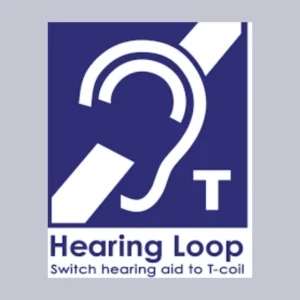
The international “T-coil” symbol shows an ear with a “T” beside it. When you see that symbol, switch your hearing aid to its telecoil program. You’ll hear the sound system directly with no background chatter and no echo.
Why Telecoils Still Matter in 2026
Hearing aid technology has changed dramatically. Bluetooth LE Audio and Auracast are rolling out as the future of public broadcast audio. So you might wonder whether telecoils are still relevant.
The honest answer is yes, for now and for a good while longer.
Auracast venues exist, but the rollout is slow. Most theaters, courtrooms, and houses of worship in our region still rely on traditional loop systems. If you only have Auracast and you walk into a looped venue, you can’t connect. With a telecoil, you can.
For most patients, the practical answer is to choose a hearing aid that supports both. Modern wireless streaming covers the future. A telecoil covers the hundreds of venues already wired today.
The Real Benefits of Telecoils
Telecoils punch above their weight. They deliver real-world benefits no other technology fully replaces yet.
Here’s what makes them worth asking for:
- Cleaner sound. Direct magnetic transmission cuts out room noise, echo, and reverb.
- No extra equipment. You don’t need to borrow a headset or check out a receiver.
- Hygiene. Loop systems require nothing physical to share. Your hearing aid is the receiver.
- Discretion. No one can tell you’re using assistive listening.
- Range. A loop covers an entire room, so you can sit anywhere inside it.
- Reliability. Loop technology is decades old, and it works.
Patients tell us the difference shows up most in three settings: worship services, live theater, and large meetings. The speaker is far from the listener. The room is acoustically challenging. A loop system simply solves it.
Telecoil Availability Across the Five Brands We Carry
We carry hearing aids from Phonak, ReSound, Starkey, Oticon, and Unitron. Most current premium models offer a telecoil option, but not all. Here’s an honest breakdown of where things stand.
| Brand | Telecoil-equipped current models | Notes |
|---|---|---|
| Phonak | Audéo Lumity (RIC); select Virto custom models | The flagship Audéo Sphere Infinio does NOT include a telecoil. Phonak prioritized AI processing over the coil in this model. |
| ReSound | Vivia RIE 13; Nexia RIE 62 and BTE models | Vivia microRIE (rechargeable) accesses loops via the Multi-Mic+ accessory rather than a built-in coil. |
| Starkey | Edge AI RIC RT; Omega AI RIC RT | Both flagship platforms offer a telecoil-equipped RIC model. |
| Oticon | Intent miniRITE and miniBTE (all tech levels) | Telecoil is standard across the entire Intent rechargeable lineup. |
| Unitron | Vivante Moxi V-RT; Stride V-UP | The Moxi V-RT is the rechargeable RIC option with a built-in telecoil. |
If telecoil access matters to you, the right hearing aid exists across every major brand. We help patients sort through these options every day. The model name on the box matters more than the brand. Just one letter separates “Moxi V-R” from “Moxi V-RT,” but only one of them includes the coil.
Telecoils vs. Modern Wireless Streaming
Newer hearing aids support a wireless protocol called Bluetooth LE Audio. They also support a public broadcast version called Auracast. Both technologies will likely do for the next decade what telecoils did for the last several.
Here’s how they compare in plain terms:
| Feature | Telecoil (Hearing Loop) | Auracast / LE Audio |
|---|---|---|
| Where it works | Looped venues like churches, theaters, courtrooms | Auracast-enabled venues plus phones and devices |
| Current public availability | Widely installed for decades | Rolling out, still limited in most regions |
| Battery use | Very low | Moderate (uses Bluetooth) |
| Setup on the user side | Switch to the T-coil program | Open the app, find the broadcast |
| Audio quality | Excellent for speech | Excellent for speech and music |
| Future-proofing | Limited as newer venues may skip loops | Strong, since this is where the industry is heading |
Both technologies can live on the same hearing aid. Several current models offer telecoil and Auracast in one package. ReSound Vivia’s RIE 13 is one example. Starkey’s Edge AI and Omega AI RIC RT models are others. This combination gives patients the most flexibility.
Who Benefits Most From a Telecoil-Equipped Hearing Aid?
Telecoils aren’t essential for everyone. For certain patients, they make a huge difference in everyday life.
You’ll get the most out of a telecoil if you:
- Attend worship services at a looped church, temple, or house of worship
- Enjoy live theater, concerts, or symphony performances
- Spend time in courtrooms, government buildings, or large meeting halls
- Travel through major airports or use Amtrak stations
- Frequent service counters at pharmacies, banks, or DMV offices with loops
A telecoil pays for itself in clarity if your weekly routine includes any looped venue. We always ask about your typical week during a hearing evaluation. Your answers tell us whether a telecoil belongs on your shortlist.
How to Use Your Telecoil
Once you have a telecoil-equipped hearing aid, using it is straightforward.
Most modern hearing aids let you switch to the telecoil program in one of three ways:
- A push-button on the hearing aid itself
- A tap or swipe in the manufacturer’s smartphone app
- An automatic switch when the aid detects a strong magnetic field
Your hearing care provider activates and programs the telecoil during your fitting. We can also create a custom telecoil program that blends a little room microphone with the loop signal. That way you can still hear someone next to you whisper a question.
Some quick tips for using telecoils well:
- Look for the international T-coil symbol when you walk into a venue.
- Sit anywhere inside the looped area, since performance stays consistent throughout.
- Tell venue staff if sound is faint or distorted, since the loop itself may be weak.
- Switch back to your default program when you leave the looped area.
Common Misconceptions About Telecoils
A few myths come up regularly in conversations with patients. Let’s clear them up.
“Telecoils are old technology, so they must be obsolete.” Older does not mean obsolete. Loop systems live in millions of venues worldwide and still appear in new builds. The technology works.
“My new hearing aid has Bluetooth, so I don’t need a telecoil.” Bluetooth LE Audio and Auracast are different from a telecoil. Bluetooth handles your phone and TV. Auracast handles future public broadcasts. Telecoils handle today’s installed loop systems. Each tool covers different problems.
“Telecoils only work for landline phones.” That was true decades ago. Today, the bigger use case is public venues. Many people use their telecoil far more often at church than on a phone.
“I won’t notice the difference.” The difference is dramatic. For many patients, a looped venue is the moment hearing aids finally work the way they’d hoped.
Where Telecoils Fit in a Modern Hearing Aid Decision
Choosing a hearing aid involves many variables. Hearing loss type, lifestyle, dexterity, cosmetic preference, budget, and connectivity needs all matter. Telecoils are one piece of that puzzle, not the whole puzzle.
A few practical considerations for your shortlist:
- Prioritize a built-in telecoil if you regularly visit looped venues
- Focus on Bluetooth LE Audio compatibility if you mainly want phone and TV streaming
- Several current models cover both bases, so your provider can match you to the right one
- A free hearing aid evaluation is the best way to sort through these options
For patients who also experience ringing or buzzing in the ears, telecoil-equipped hearing aids pair well with our tinnitus support approach. Cleaner audio in challenging environments often reduces the listening effort that worsens tinnitus.
The Americans with Disabilities Act requires public venues and businesses serving the public to provide effective communication options for people with hearing disabilities. The law specifically names assistive listening systems as a qualifying auxiliary aid. That federal protection helps explain why loop systems remain so common in public spaces.
Schedule a Free Consultation at Stanford Hearing
We’ve spent more than 20 years helping patients across the Sioux Falls and Buffalo communities find the right hearing solution. Telecoils are one part of that conversation. They may be the part that finally makes worship services, theater nights, and public meetings feel easy again.
When you visit us, you’ll get:
- A free consultation with a hearing care provider who listens first
- Our 10-day trial period to test your hearing aids in real life
- Access to all five major brands so we can match the right technology to your lifestyle
- A price match guarantee on the hearing aid brands we carry, including Phonak hearing aids, ReSound, Starkey, Oticon, and Unitron
- No-interest financing options to make premium hearing technology accessible
- Help verifying your insurance benefits, including Medicare Advantage plans we accept
- Two convenient locations in Sioux Falls, SD and Buffalo, MN
Ready to find out whether a telecoil-equipped hearing aid is right for you? Schedule a free consultation and we’ll walk you through your options.
Frequently Asked Questions About Telecoils
Are telecoils standard in all hearing aids?
No. Telecoils are an optional feature, and not every hearing aid model includes one. Some current flagship models like the Phonak Audéo Sphere Infinio leave the telecoil out. Other flagships, like Oticon Intent and Starkey Omega AI RIC RT, include a telecoil as standard. Always ask before you buy.
Do I need to be in a specific seat to use a telecoil at a looped venue?
No. A properly installed loop system covers the entire designated listening area. You can sit anywhere inside the loop, and signal strength stays consistent. Look for the T-coil symbol at the entrance to confirm the venue is looped.
Will a telecoil drain my hearing aid battery faster?
The telecoil itself uses very little power. You may notice a small drop in battery life if you run the telecoil program for hours. The impact stays much smaller than streaming audio over Bluetooth. Most patients don’t notice a meaningful difference.
Can I use a telecoil with my smartphone?
Telecoils don’t suit modern smartphones, which have largely moved away from magnetic phone coils. Bluetooth LE Audio is the better technology for phone calls today. Telecoils still shine in looped public spaces.
What’s the difference between a manual and an automatic telecoil?
A manual telecoil requires you to press a button or open an app to activate. An automatic telecoil senses a strong magnetic field and switches over on its own. Most current models offer either approach. Your hearing care provider can set this up the way you prefer.
Are telecoils being replaced by Auracast?
Eventually, possibly, but not soon. Auracast is rolling out gradually. It may take years to reach the same coverage as installed loop systems. The smartest move today is choosing a hearing aid that supports both.
How do I know if my current hearing aids have a telecoil?
Check your owner’s manual or the original fitting paperwork. The model name often includes a letter like “T” or “RT” for the telecoil version. Bring your hearing aids to one of our offices if you’re unsure. We’ll check the firmware and programming for you at no charge.
Can telecoils help with tinnitus?
Telecoils don’t treat tinnitus directly. Cleaner audio with less background noise can reduce the listening effort that worsens tinnitus. Many patients find their tinnitus feels less noticeable in looped venues. Their brain simply isn’t working as hard to process speech.