Phonak Audeo EON: What the New Platform Means for Your Ears
September 20, 2026 | By Dr. Jade Husby, Au.D.
Short Version
- Phonak Audeo EON arrives as two separate product lines, not one ladder of tiers.
- EON Sphere carries Spheric Speech Clarity 3.0 at the 90, 70 and 50 levels.
- EON R carries it at no level at all, including EON R 90.
- Which line suits you comes out of your hearing test, not out of the number on the box.
Read the tier numbers on Phonak Audeo EON the way you would read any other range and you will pick the wrong one. We fit both EON lines inside our Phonak lineup, and the number on the box is not what decides which suits you. A higher number buys more processing and more fine tuning, and it does not buy the thing most people walk in asking about, which is holding a conversation across a loud restaurant table. That comes down to which of the two lines you are looking at, and they are easy to mix up because they share a numbering scheme.
What Phonak Audeo EON Is
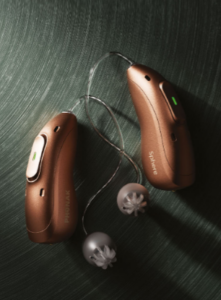
Phonak Audeo EON is a receiver in canal platform, which means the small body sits behind your ear and a thin wire carries a receiver down into the canal. Every EON model is rechargeable, and there is no battery door version anywhere in the family. Both lines run the same operating system, AutoSense OS AI 8.0, which is the part of the aid that listens to the room and shifts settings without you touching anything. Underneath that sits Phonak’s HYPERSONIC chip, shared by every model in the family.
Shared across every EON model, Sphere and R alike:
- Rechargeable only, with a full charge in about two and a half hours and a fifteen minute top up that is enough to get you through a fitting appointment.
- An IP68 rating, tested at an hour of immersion in a meter of fresh water plus eight hours in a dust chamber.
- Five receiver strengths, from the S for mild loss up to the UP, which reaches losses in the profound range.
- Eight housing colors, from Sand Beige through to Velvet Black and Sienna Red.
- The myPhonak app, plus Auracast and Bluetooth LE Audio on every model.
None of that changes between the two lines, which is exactly why the difference that does change is so easy to miss.
Two Lines, Not One Ladder of Tiers
Spheric Speech Clarity 3.0 is the second processing layer that separates a talker’s voice from the noise around it, and it lives on the EON Sphere line only. Phonak built EON as two physically different products rather than one range, so reading the tiers as a single ladder from 90 down to 30 will send you to the wrong aid. An EON R 90 is a premium device with premium fine tuning and it has no Spheric processing in it, while an EON Sphere 50 sits lower in the range and does.
EON Sphere, the line with Spheric Speech Clarity 3.0:
| Level | Spheric Speech Clarity 3.0 | Fine tuning channels |
| EON Sphere 90 | Yes | 20 |
| EON Sphere 70 | Yes | 20 |
| EON Sphere 50 | Yes | 16 |
EON R, the line without it:
| Level | Spheric Speech Clarity 3.0 | Fine tuning channels |
| EON R 90 | No | 20 |
| EON R 70 | No | 20 |
| EON R 50 | No | 16 |
| EON R 30 | No | 12 |
What changed this time around is where the Sphere line stops. On the previous generation the Spheric processing did not reach the 50 level, and Phonak’s professional launch notes record that it now does. That matters for anyone who was told a year ago that the noise processing sat out of reach.
How EON Sits Beside Infinio, Lumity and the Rest
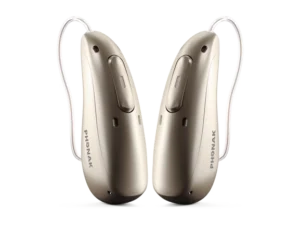
Phonak Audeo EON takes the newest slot in the lineup and it pushes nothing out of it. Infinio and Lumity are both still sold, and so are the ReSound platforms we fit alongside them. Patients ask us this one nearly every launch, usually worried their two-year-old aids just became obsolete. They did not. A new platform widens the menu, and a launch is not a reason to replace an aid that is working for you.
What a launch does and does not change:
- Infinio and Lumity stay available, so a Phonak fitting today is not a choice between new and nothing.
- Your current aids keep the same manufacturer support they came with, whatever launches after them.
- EON adds Auracast across every level, which older platforms carry unevenly.
- The newest platform is not automatically the right one, since the right one follows your hearing test.
Where EON does pull ahead is the noise processing reaching further down the range, which is the comparison worth having.
| EON Sphere | Infinio Ultra Sphere | EON R | |
| Spheric processing | Yes, at 90, 70 and 50 | Yes | No |
| Operating system | AutoSense OS AI 8.0 | Previous generation | AutoSense OS AI 8.0 |
| Expected wear time | 22 hours | See fitting notes | 29 hours |
| Auracast | Yes | Varies by model | Yes |
If you want to see how the previous generation sorts itself out before comparing it with EON, we keep a breakdown of comparing Phonak Infinio models, along with pages on Phonak’s flagship speech in noise model and the rechargeable Phonak Audeo Infinio.
Battery Life and Charging Across the Range
The two lines do not last the same number of hours, and the reason is the processing rather than the battery. Spheric analysis runs continuously and draws power to do it, so an EON Sphere is rated for about 22 hours of expected wear where an EON R is rated for about 29, with both reaching a maximum of 38 hours in undemanding conditions. Phonak states the 22 hour Sphere figure with streaming already built into it rather than as a quiet day best case.
Charging works the same way across the family:
- A full charge from empty takes about two and a half hours.
- An hour on the charger gets you to roughly 55 percent, which covers an afternoon out.
- Two hours gets you to about 90 percent.
- Fifteen minutes is enough for a fitting appointment, which is why we can charge an aid while we talk.
Two chargers fit the whole family, a desktop unit for the nightstand and a portable one with its own battery, which is the one our patients heading to the lake in the summer tend to ask for.
Connectivity Is the Same on Every EON Model
Every EON model handles Bluetooth the same way, so connectivity is not a reason to move up a level. The aids hold up to eight paired devices and run two of them at a time, which in practice means a phone and a tablet or a phone and a laptop without unpairing anything. Auracast is on every model in both lines, and that is the broadcast standard that lets a theater, an airport gate or a church send audio straight to your hearing aids instead of through a loop.
What EON connects to out of the box:
- Phones, tablets and computers over Bluetooth, with hands free calling supported.
- Auracast broadcasts in venues that have installed a transmitter.
- Phonak’s TV Connector, PartnerMic and RemoteControl accessories.
- Roger microphones, which pick up a single voice across a noisy table.
- The myPhonak app for volume, programs and remote adjustments.
If Auracast is new to you, we have written separately on Auracast and hearing aid connectivity.
Single Sided Hearing and the CROS EON R
When amplification cannot reach one ear, a CROS device is the answer, and EON has one. A CROS device sits on the unaidable ear, picks up the sound arriving on that side and sends it wirelessly to a hearing aid on your better ear, so you stop losing half the table at dinner. Phonak calls this one CROS EON R, and you may see Phonak CROS E-R on your paperwork at the fitting, which is the same device under its technical name.
One detail decides whether this route is open to you:
- CROS EON R pairs with the EON R line only, so it does not pair with EON Sphere.
- The features you end up with follow the level of the aid on your better ear, not the CROS device.
- A CROS balance control lets us set how loud the transmitted side sits against your better ear.
- Custom and dome fittings are both available, so a CROS device is not limited to one earpiece style.
That pairing rule is worth knowing before you fall for the Sphere line, and it is a good example of why a single sided loss gets sorted in person. More on how the setup works sits in our explainer on understand CROS hearing aids.
Which Phonak Audeo EON Line Is Best If You
There is no single best hearing aid, only the one that is best for you, so treat these as starting points for a conversation rather than verdicts.
- EON Sphere is best if you spend real time in loud rooms, restaurants, fellowship halls, a busy shop floor, and you tell us that following speech in noise is the problem you want solved.
- EON Sphere at the 50 level is best if you want the noise processing but do not need the widest fine tuning, since this is the first generation where the Sphere line reaches that far down.
- EON R is best if you do most of your listening in ordinary rooms and one to one conversations, where the extra hours of wear time are worth more to you than processing you would rarely hear working.
- EON R at the 30 level is best if you have a straightforward loss and want current connectivity without paying for fine tuning you will not use.
- CROS EON R is best if you have one ear that cannot be aided and want sound from that side routed across.
Every one of those still runs through your audiogram, because the degree and shape of your loss decide which receiver you need before the line question comes up at all.

What Fitting an EON Here Involves
Picking a line is the easy half. What decides whether you like the aids is the fitting, and it works by measurement rather than by ear.
Why Real Ear Measurement Changes the Result
When we program a hearing aid, the software starts from a prescription built on your hearing test, and that prescription assumes an average ear canal. Yours is not average. A narrow canal, a longer one, or the style of dome we use will shift how much sound reaches your eardrum, sometimes by enough to make a well chosen aid sound thin or sharp. Real ear measurement closes that gap with a soft probe microphone in the canal alongside the receiver, reading what arrives at the eardrum while the aid runs, so we tune against what you hear instead of what the software predicted. As ASHA’s clinical guidance on adult hearing aids puts it, real ear testing lets the clinician measure the sound a specific hearing aid delivers to a specific individual, which allows for a more accurate fitting.
A first appointment with us runs in this order:
- A full hearing evaluation, so the prescription starts from your ears rather than an estimate.
- A conversation about the rooms you struggle in, which is what decides Sphere against R.
- A trial fitting with real ear verification, using live speech mapping so you can see the match.
- Follow up visits to adjust as your brain settles in over the first few weeks.
The sequence runs the same whichever line you land on, which is why we would rather see you in a chair than sell you a level over the phone. More sits in our hearing evaluation process and in professional hearing aid fittings.
Why Choose Stanford Hearing for Your Phonak Audeo EON Fitting
Locally owned for 20-plus years in Sioux Falls and Buffalo, Minnesota, and voted Sioux Falls Local Best 20 years, we have a record that only comes from patients coming back. Our team carries five premium brands and recommends based on your hearing, your lifestyle and where you most want to hear well, and every device we fit is unlocked.
What you get when you book with us:
- Free consultations with no pressure to buy, so your first appointment costs you nothing but the hour.
- A 10-day trial so you can wear your hearing aids in real life before you decide, and if they are not right for you, return them inside your trial window for a full refund.
- Options for every budget across Phonak, ReSound, Starkey, Unitron and Oticon.
- Your hearing aids come with the manufacturer’s warranty, including loss and damage coverage, and terms vary by brand and model.
- A price match guarantee, so you will not overpay locally. Bring us another local clinic quote and we will take a look.
- 12 months no-interest financing for qualifying patients, subject to credit approval.
- In-network with all major insurance providers, including Medicare Advantage. Original Medicare does not cover hearing aids, many Medicare Advantage plans include a hearing benefit, coverage varies by plan, and we verify your benefits before your appointment.
- Hands on care from testing to fitting to follow up, in person, at our Sioux Falls hearing center or our Buffalo hearing center.
Come in with questions and leave with a plan. Schedule a free consultation and we will walk you through what we find, whether Phonak Audeo EON turns out to be your fit or something else does.
Common Questions About Phonak Audeo EON
Should I wait for Phonak Audeo EON or get fitted now?
If your hearing is making conversations hard, waiting costs you more than the platform gains you. EON is available to order through Stanford Hearing now, and Infinio and Lumity are both still sold, so a new platform does not put the older options off the table. Come in, get tested, and we will sort the timing with you.
Can I try Phonak Audeo EON before I commit to it?
Yes. Every purchase at Stanford Hearing includes a 10-day trial so you can wear your hearing aids in real life before you decide, and the Phonak Virto trial is 30 days. If they are not right for you, return them inside your trial window for a full refund.
Do I need a newer phone to use Phonak Audeo EON?
Probably not. EON uses standard Bluetooth rather than a proprietary link, so most phones already in people’s pockets will pair with it. Bring your phone to your fitting at Stanford Hearing and we will pair it, set up streaming and show you the app before you leave.
Does Medicare cover Phonak Audeo EON?
Original Medicare does not cover hearing aids, and many Medicare Advantage plans include a hearing benefit, though coverage varies by plan. Stanford Hearing is in-network with all major insurance providers, including Medicare Advantage, and we verify your benefits before your appointment so you know what is covered before you commit.
Do you fit Phonak Audeo EON at both of your clinics?
Yes. Our team fits the full Phonak range at both Stanford Hearing locations, in Sioux Falls, South Dakota and in Buffalo, Minnesota. Whichever clinic you come to, the testing, the real ear verification and the follow-up adjustments work the same way.
This content is for informational purposes and is not a substitute for medical advice, diagnosis, or treatment. If you notice a sudden change in your hearing, see a licensed medical professional.