
Choosing the Right Hearing Aid Domes
Updated June, 2026
Those small silicone tips on your hearing aids shape your whole listening experience. Hearing aid domes types matter, and so does size, for clear and comfortable sound. Pick well and your aids seal cleanly, sit securely, and deliver sound your ear loves. This guide covers every dome type, sizing, and how to land the right fit.
What Hearing Aid Domes Are
Domes are the soft silicone tips on receiver-in-canal hearing aids. They sit in your ear canal and channel sound from the device to your eardrum. Think of them like earbud tips, but built for hearing care. They come in several shapes and sizes to match your ear and your hearing loss. The hearing aid domes types you choose then shape how that sound feels.
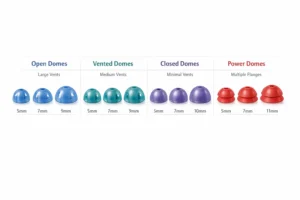
Hearing Aid Domes Types: Open, Closed, and Power
Hearing aid domes types fall into three main families, plus a few specialized styles. Your hearing loss and lifestyle point to the right one.
Open Domes
Open domes have small vents that let natural sound pass through alongside amplified sound. They cut the plugged-up occlusion feeling, so your own voice sounds natural. Most people with mild to moderate loss find them comfortable all day. The tradeoff is less low-frequency power and a bit more feedback risk.
Closed Domes
Closed domes have fewer, smaller vents and seal the canal more tightly. They push more low-frequency power and tame feedback better than open styles. Moderate to severe loss and noisy rooms are their sweet spot. The tradeoff is a bit more occlusion until you adjust.
Power Domes
Power domes seal completely, with no vents at all. They deliver maximum amplification and almost no feedback. For severe hearing loss, they are the go-to. Expect the most plugged feeling and a short adjustment period.
Tulip and Vented Domes
A few specialized styles split the difference. Tulip domes taper for a deeper fit and cut wind noise, which outdoor folks like. Single-vent and double-vent domes tune the balance between comfort and amplification. Some makers add wax-protection membranes that keep debris out of the receiver.
Here is how the hearing aid domes types compare at a glance:
| Dome type | Best for | Amplification | Occlusion | Feedback risk | Comfort |
|---|---|---|---|---|---|
| Open | Mild to moderate loss | Low to moderate | Minimal | Higher | Most comfortable |
| Closed | Moderate to severe loss | Moderate to high | Moderate | Lower | Comfortable |
| Power | Severe loss | Maximum | Complete | Minimal | Adjusts over time |
| Tulip | Severe loss, outdoors | High | High | Low | Moderate |
| Vented (single/double) | Mild to moderate loss | Moderate | Low to moderate | Moderate | High |
Open versus closed is the most common call. It hinges on how much low-frequency power you need. Clinical research found that open domes pass more high-frequency sound than power domes. You can hear that difference.
Hearing Aid Dome Sizes and Size Chart
Once you have the hearing aid domes types sorted, size is the next call. Type sets the sound, and size sets the comfort and the seal. Domes run from small to extra-large, and the widest point marks the size. Exact sizes vary by manufacturer, so treat this chart as a general guide:
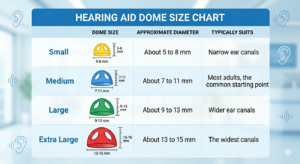
Too small, and the dome slips and whistles. Too large, and it feels tight or muffled. Your provider measures and confirms the right size.
How to Find Your Right Fit
Picking the dome is a team effort with your hearing care provider. Here is what a fitting looks like:
- They measure your ear canal and your hearing loss pattern
- You try sizes and styles until one seals without pressure
- They check for clear sound with no whistling
- You practice insertion and removal before you leave
A good fit feels secure but never painful, and it stays put all day. Research on dome acoustics in 2025 concluded that individual real-ear testing should guide the choice. For more, see our guide to selecting the best dome for you. Our list of questions to ask at a fitting helps you prepare. The right dome is a fitting decision, not a guess. We confirm it during a professional hearing aid fitting, matched across the five brands we carry. We verify the result objectively too. A real-ear measurement confirms your domes deliver the sound your audiogram calls for.
When Domes Aren’t Enough
Domes fit most people, but not every ear or every hearing loss. Custom earmolds step in when a stock dome cannot seal or stay put. They suit severe loss, unusual canal shapes, or chronic retention trouble. We make custom earmolds to your exact anatomy.
Single-sided hearing has its own answer. A CROS system routes sound from the weaker ear to the better one. It uses its own fittings. If one ear hears little, our guide to CROS hearing aids explains the options.
Caring for and Replacing Your Domes
Fresh domes simply sound better. Old ones harden, trap wax, and can hold moisture that harms your aids. Most people replace domes every two to three months, sooner with heavy earwax. Watch for these signs it is time:
- Stiff, discolored, or cracked silicone
- Wax buildup you cannot wipe away
- Muffled sound or new feedback whistling
- A loose fit that will not stay seated
Between changes, a little daily care goes a long way:
- Wipe domes each evening with a soft, dry cloth
- Skip water and solutions unless your provider approves
- Store aids in a dry case, away from heat and sun
- Handle gently, and keep spares on hand
For routine help, our repair and maintenance team keeps your aids in shape. Our cleaning dos and don’ts cover the daily basics.
Fixing Common Dome Problems
Most dome issues have simple fixes. This quick reference covers the common ones:
| Problem | Likely cause | First step | See a provider if |
|---|---|---|---|
| Whistling feedback | Too small or damaged | Try a larger size or closed style | It persists after a fresh dome |
| Discomfort or pressure | Too large | Try a smaller size | Pain lasts more than two days |
| Muffled sound | Wax blockage | Clean, then replace the dome | No change after cleaning |
| Dome falls off | Loose on the receiver | Press on firmly until it clicks | It keeps detaching |
| Dome stuck in the ear | Improper removal | Do not dig for it yourself | Right away, every time |
One firm rule: never fish out a stuck dome with tweezers or swabs. Call us or your doctor, since the right tool makes it quick and safe. Stubborn feedback often traces to fit, which our post on stopping hearing aid feedback covers.
Matching Domes to Your Lifestyle
Your daily life shapes which hearing aid domes types fit as much as your audiogram. A few patterns:
- Active and outdoors: tulip or closed domes stay secure and cut wind
- Noisy workplaces: closed or power domes block distraction and focus speech
- Musicians: open domes keep sound natural and true
- Frequent infections or drainage: open, vented styles let air move
If you have tinnitus, open domes can let in natural sound that softens the ringing. Pause dome use during an ear infection, and replace domes once it clears.
About the Author
Dr. Jade Husby, Au.D., owns and leads Stanford Hearing. She earned her Doctor of Audiology at the University of South Dakota. Her residency took place at an Ear, Nose, and Throat clinic. Today she helps Sioux Falls patients hear their best, one fitting at a time.
Why Choose Stanford Hearing for Your Dome Fitting
The right hearing aid domes types and size start with a hands-on fitting. For 20+ years, our locally owned practice has fitted patients across Sioux Falls and Buffalo. We measure, test, and fine-tune until your domes feel like nothing and sound like everything. Here is what you get with us:
- A free consultation and a 10-day trial, so you can decide with confidence
- Five premium brands, a price match guarantee, and no-interest financing
- In-network insurance, including Medicare Advantage, plus benefit verification
- Two locations, in Sioux Falls and Buffalo, whichever is closer
Ready to hear better with confidence? Talk with a hearing care provider who listens. Schedule a free consultation and we will dial in the dome that fits you.
Hearing Aid Domes Types: Common Questions
What size hearing aid dome do I need?
Size comes down to your ear canal, not a guess. A dome should feel snug but never tight. It should stay put when you chew or talk, with no whistling. At Stanford Hearing, we measure your canal and try sizes until one fits right.
Can I change my dome type or size myself?
It is best not to, at least not the type. We program your aids for the current dome. A new type can change the sound. Swapping a worn dome for the same size and style is fine. For anything else, let Stanford Hearing adjust and reprogram so it sounds right.
Do hearing aid domes come in different colors?
Mostly clear or smoke gray, since they hide inside your ear canal. A few makers offer more options, but color does not change the sound. At Stanford Hearing, we put fit and comfort first, then color if there are choices.
Can the wrong dome make my hearing aids sound worse?
Yes, more than people expect. The wrong type can leave low sounds thin. The wrong size can leak sound or muffle it. That is why a quick professional check pays off. Stanford Hearing matches the dome to your audiogram. Then you hear all your aids can do.