
Best Hearing Aids: What We Fit in Sioux Falls and Buffalo
Short Version:The best hearing aids 2026 offers come from five premium brands, and no single model wins for everyone. Phonak EON leads on speech in noise. ReSound Sensia leads on connectivity. Starkey Omega AI leads on health sensors. Unitron Smile leads on flexibility. Oticon Zeal leads on discretion.
Most roundups of the best hearing aids 2026 come from writers who have never looked inside anyone’s ears. We fit these devices every week at two clinics, so this list reflects what holds up in a church basement and across a loud dinner table. Quality across the premium tier sits close together now, which turns the question from which model into which fit. The five brands we carry pull apart in five different places, and overlap more than the marketing admits.

How We Judge the Best Hearing Aids 2026 Has to Offer
Specification sheets sell devices. They do not predict whether you will still be wearing yours in March.
Five things carry weight when we recommend a model:
- Speech clarity in the rooms where you struggle most, not in a sound booth
- Physical comfort, and whether your fingers can manage the device on a cold morning
- Connectivity that matches the phone and the television you already own
- Battery life measured against your day, including the evening you did not plan for
- Follow-up support once the newness wears off and something needs adjusting
Only two of those five involve the device itself. Federal guidance from the NIDCD on choosing hearing aids lands in the same place. A more expensive hearing aid, it cautions, does not necessarily suit your needs better. Ranking hardware alone misses most of what decides whether a fitting works.
The Best Hearing Aids This Year at a Glance
Each model on this best hearing aids 2026 list is a current flagship, verified against the manufacturer. Technology levels inside each family change the price and the feature set, so the badge on the box is only half the story.
| Brand and model | Standout strength | Best if you |
|---|---|---|
| Phonak Audeo EON Sphere | Two chips, one devoted to separating speech from noise | Spend your week in restaurants, meetings, and crowded rooms |
| ReSound Sensia | Four microphones that steer with your head, plus Auracast | Stream often and want the device deciding for itself |
| Starkey Omega AI | Health sensors, a telecoil, and the longest battery of the five | Track your activity and sit in looped auditoriums or churches |
| Unitron Smile | Trial and upgrade programs that let you test a level first | Worry about paying for more device than your week needs |
| Oticon Zeal | Flagship processing inside a rechargeable in-ear shell | Want something that all but disappears in your ear |
Those are five different corners rather than five places on a ladder. Our overview of the hearing aid brands we carry covers each family in more depth. Any honest list of the best hearing aids 2026 ends up shaped this way. The strongest device is the one matched to your ears and your habits.
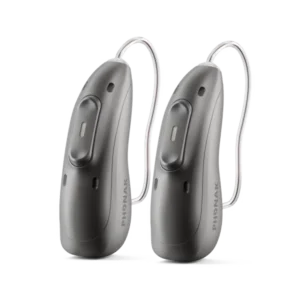
Phonak Audeo EON Sphere
Phonak built its name on speech in noise, and the EON platform pushes that further than the Infinio generation it replaces. The device runs two chips instead of one. ERA handles processing and connectivity, and HYPERSONIC adds real-time AI sound processing that does nothing else.
What the EON Sphere brings:
- Spheric Speech Clarity 3.0, active automatically at full strength across 20 channels
- AutoSense OS AI 8.0, which reads the room and shifts settings as it changes
- Auracast broadcast audio and WindBlock 2.0, both standard on the platform
- Up to 38 hours of battery on a charge
- Coverage from mild through profound hearing loss, with an IP68 rating
Patients who dread group dinners tend to notice the difference first, often in the first week. One change from the previous generation matters if you have shopped before. Auracast now comes built in, so airports, theaters and looped churches broadcast straight to the device. Our Phonak hearing aids overview covers the wider family, including the EON models below the Sphere tier. Phonak opens most of the best hearing aids 2026 conversations we have in the clinic.
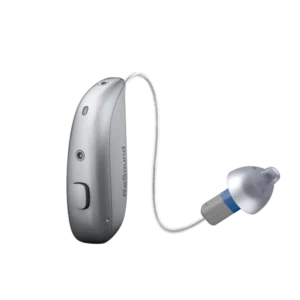
ReSound Sensia
Three systems run at once inside the Sensia, and none of them wait for you to open an app. Wireless connectivity has been ReSound’s territory for over a decade, and Sensia keeps that ground while changing what the microphones do.
The Sensia story sits in the hardware:
- An AcoustIQ classifier that reads the environment before deciding anything
- Four synchronized microphones that aim a beam wherever you turn your head
- Deep neural network denoising that softens whatever is not the voice you came for
- Bluetooth LE Audio with Auracast, in a small rechargeable microRIE housing
- Up to 24 hours on a charge, fitted from mild through severe hearing loss
ReSound calls the combination Intelligent All-Around, and the practical version is that the device commits to a decision faster than you would. Battery is the honest tradeoff here, since 24 hours asks you to charge nightly rather than skip a day. There is no telecoil in this housing either, which matters in older looped venues. Compare the family on our ReSound hearing aids overview.
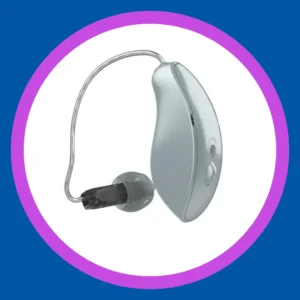
Starkey Omega AI
Starkey is the only American-owned manufacturer of the five, based just up the road in Minnesota. Their devices do more than amplify, which appeals to patients already tracking steps and sleep.
Omega AI includes:
- Personal health monitoring through embedded sensors and onboard AI
- Directionality that reads the full 360 degrees rather than only what is in front of you
- Up to 51 hours of battery, or up to 45 hours with streaming
- A telecoil and CROS support, both rarer than they used to be
- Tinnitus technology built into the platform, with an IP68 rating
Health features are real, and they matter to some patients and not at all to others. Ask yourself whether you will open the app twice a week. Someone who never touches a phone is paying for capability that sits idle. Our Starkey hearing aids overview has the model breakdown.
Unitron Smile
Most manufacturers ask you to pick a technology level on faith. Unitron, which shares parent ownership and core chip architecture with Phonak, lets you drive one first.
The flexibility comes down to three things:
- A trial program that lets you wear a technology level in your own week first
- An upgrade program that raises the level later without replacing the hardware
- A fitting path that suits patients who would rather start lower and move up
That structure suits anyone who worries about overbuying, which is most people sitting in our chairs for the first time. You can start at a middle level, live with it through a real month, and move up if your listening life demands more. See the range on our Unitron hearing aids overview.
Oticon Zeal
Oticon takes a different philosophical route, giving your brain access to the fuller sound scene instead of suppressing everything around a conversation. Zeal puts that processing somewhere it has not fit before.
Zeal is built around size:
- Oticon’s smallest in-ear device carrying the full feature set, on the Sirius platform
- MoreSound Intelligence 3.0 with AI-driven clarity enhancement, across 64 processing channels
- Bluetooth LE Audio, Auracast broadcast, hands-free calling, and tap control
- Up to 24 hours of rechargeable power, with an IP68 rating
- Tinnitus SoundSupport included on the platform
Patients who dislike the closed-in feeling of aggressive noise reduction often prefer how Oticon sounds. The tradeoff is directional microphones, which a device this small does without. A loud restaurant therefore asks more of it than a behind-the-ear model would. Oticon is a limited, by-order offering for us rather than a stocked line, so plan for a short wait. Our guide to Oticon hearing aids covers the brand’s approach in full.
Technology Levels Matter More Than the Model Name
Every roundup skips this part. The best hearing aids 2026 offers all sell at several technology levels, and the level moves performance more than the badge does.
| Level | What you gain | Best if you |
|---|---|---|
| Premium | Maximum automatic adjustment and the strongest noise handling | Keep a busy social calendar or work in a demanding environment |
| Advanced | Most premium features with slightly less automation | Split your time between quiet settings and occasional noise |
| Essential | Core amplification and connectivity, with fewer programs | Spend most of your day in quiet, predictable spaces |
An advanced device fitted well beats a premium device fitted poorly, every time. We would rather move you down a level and spend the difference on the right receiver, then use live speech mapping to prove the fitting hits target.
Matching a Model to Your Listening Life
Scenarios beat specifications, which is where the best hearing aids 2026 question turns into a matching question. The five brands sort cleanly by the situations patients describe when we ask about their week.
| Your hardest situation | What to prioritize | Where we usually start |
|---|---|---|
| Restaurants and group conversation | Dedicated speech separation | Phonak, with Starkey as the alternative |
| Streaming, phone calls, and broadcast audio | Auracast and Bluetooth LE Audio | ReSound, with Oticon close behind |
| Staying active and tracking your health | Sensors, telecoil, and long battery | Starkey |
| A tight budget with room to grow | Trial and upgrade flexibility | Unitron |
| Wanting the device to go unnoticed | A small rechargeable in-ear fit | Oticon |
Two patients with matching audiograms often leave with different brands, because their weeks look nothing alike. Tinnitus deserves a note here too. All five brands offer sound therapy options, and many patients use them to manage the ringing and reduce how much it intrudes. None of them cures tinnitus, and any seller who tells you otherwise is worth walking away from.
Discreet and In-the-Ear Options
Not everyone wants something visible behind the ear, and that preference is worth saying out loud at the first appointment. Rechargeable in-the-ear styles were rare until recently, and Zeal is the clearest example of how far they have come.
Three tradeoffs come with going smaller:
- Custom styles need ear impressions, so plan a short wait between appointments
- Dexterity matters more, because smaller devices ask more of your fingers
- Battery life drops as the housing shrinks, which is physics rather than marketing
Directional microphones are the other quiet cost, since the smallest housings often leave them out. Weigh that against how much the visibility bothers you, and say so plainly at the fitting. Several of the brands we carry build custom styles, so bring the question with you rather than assuming the answer.
Accessories That Change the Answer
Accessories sometimes matter more than the technology tier. A mid-level hearing aid plus the right microphone can outperform a flagship working alone.
Three accessories earn their keep most often:
- Remote microphones, worn by a spouse or a presenter across a table or a room
- Television streamers, which send audio straight to both devices without lag
- Chargers with drying functions, useful through humid summers and active weeks
Phonak’s microphone ecosystem runs deepest of the five brands, and we factor accessories into the recommendation rather than selling them to you later. Remote microphones surprise people most. A device that struggles across a long dinner table often performs beautifully once a small microphone sits near whoever is talking. That fix costs less than jumping a technology level.
What Best Hearing Aids 2026 Lists Get Wrong
A ranking can compare two devices. It cannot compare two ears, and that is where the decision gets made.
Three factors no list can account for:
- Your audiogram, which decides how much amplification each frequency needs
- Your ear canal shape, which changes how sound arrives at the eardrum
- Your dexterity and eyesight, which decide what you can handle every day
There is also a category question worth settling early. The FDA guidance on over-the-counter hearing aids is specific. Those devices are intended for adults with perceived mild to moderate hearing loss, and the FDA states plainly that they are not for treating severe or profound loss. Only a licensed hearing care professional can program prescription devices to measured hearing. Our guide to the 6 best hearing aids for noisy environments goes model by model on that one scenario.
Trying These Models in Sioux Falls and Buffalo
Reading about the best hearing aids 2026 helps. Wearing two of them for ten days settles it.
A first visit with us runs in three parts:
- A full hearing evaluation, plus a real conversation about how your week sounds
- A narrowing from five brands to two realistic candidates for your hearing
- A trial at home with the stronger candidate, in your own rooms rather than our office
Come to our Sioux Falls hearing center or our Buffalo hearing center, whichever sits closer. Both clinics carry all five brands and run the same trial. Bring your phone, and think before you come about the one room you most want back. Church acoustics, farm equipment, and grandchildren with quiet voices all point toward different recommendations, and we hear all three regularly across South Dakota and western Minnesota.
Why Choose Stanford Hearing for the Best Hearing Aids 2026
Locally owned for more than 20 years, and voted Sioux Falls Local Best 20 years in a row. Carrying five brands means we have no reason to steer you toward one manufacturer.
Your fitting with us comes with:
- Free consultations with no pressure to buy, and no obligation at the first appointment
- A 10-day trial so you can buy with confidence, with a full refund if you return them inside it
- Five premium brands, so the recommendation stays yours rather than a supplier’s
- A price match guarantee, so you will not overpay locally on a comparable device
- 12 months no-interest financing, subject to credit approval
- In-network coverage with all major insurance providers, including Medicare Advantage, with benefits verified before your appointment
- Two clinics, in Sioux Falls, South Dakota and Buffalo, Minnesota
Every item above applies at both locations, without exception. Whichever of the best hearing aids 2026 offers suits your ears, the fitting is what makes it work. Talk with a hearing care provider who listens first and recommends second. Schedule a free consultation whenever the timing suits you.
Common Questions About the Best Hearing Aids 2026
Which brand do you fit most often?
The mix shifts with whoever walks in, so no single brand dominates. Stanford Hearing carries Phonak, ReSound, Starkey, Unitron, and a limited Oticon offering by order, which is exactly why we can say that. A clinic naming one brand as universally best is telling you about its contracts.
Do I need the newest platform to hear well?
No, and plenty of our patients choose a previous generation happily. Stanford Hearing still fits prior flagships from several brands, and they perform well for most listening lives. The savings often buy a better receiver choice or a longer service plan.
Can I compare two brands during the same trial?
We usually run one brand at a time so your comparison stays clean. Stanford Hearing can arrange a second trial when the first one leaves a real question unanswered. Wearing two devices at once tends to muddy what you notice.
How often do these models get replaced by newer versions?
Manufacturers refresh flagship platforms every few years, with firmware updates in between. Stanford Hearing installs those free updates for our patients, and an update sometimes adds features to a device you already own. Waiting for the next release rarely pays off, because something newer is always coming.
What happens if I chose the wrong model?
You tell us during the trial and we change direction. Stanford Hearing would rather swap devices in week one than watch them sit in a drawer until spring. Nothing is final until you like what you hear.