
A Resound Hearing Aid or a Starkey Hearing Aid?
Updated September 2026 · Dr. Jade Husby, Au.D.
Short Version ReSound vs Starkey hearing aids comes down to how you want the work done. ReSound Sensia leans on a dedicated neural chip that separates speech from noise. Starkey Omega AI leans on long battery life, health tracking, and instant tap adjustments. Both stream, both handle tinnitus, and the right one depends on your ears.
Two of the five brands we fit here in Sioux Falls get asked about more than the rest, and people usually arrive having already read three conflicting articles about them. ReSound vs Starkey hearing aids is a fair question to bring to an appointment, because the two companies solve the same problem in visibly different ways. One builds around a dedicated chip for pulling voices out of noise. The other builds around endurance, body sensors, and a button you press when a room gets hard. What follows is how the two differ, and what that means for the way you spend your days.
How ReSound vs Starkey Hearing Aids Differ in Practice
Anyone weighing ReSound vs Starkey hearing aids should start here. Both brands make excellent devices. That is the honest starting point, and it is why we carry both rather than pushing one. Differences that matter are not about which company is better, they are about which set of trade-offs suits you.
Here is where the two brands diverge in practice:
- ReSound puts its newest engineering into speech separation, with a second chip whose only job is running a neural denoiser
- Starkey puts its newest engineering into all-day endurance and body sensing, including step and activity tracking built into the device
- ReSound routes TV sound through a small accessory, while Starkey Omega AI streams from a TV directly
- Starkey’s Edge Mode gives you a manual button for a hard moment, while ReSound Sensia 9 makes that call for you automatically
Neither approach is a gimmick. They reflect two different bets about what a wearer wants, and the fitting appointment is where we find out which bet matches your life.
Inside the ReSound Lineup We Fit
ReSound sits inside the GN group, and its recent work has gone almost entirely into noise. The newest platform we fit arrived in August 2026.
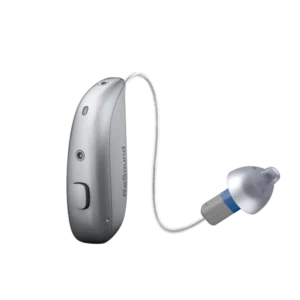
ReSound Sensia 9 and Sensia 7
Sensia runs a dual chip design with a deep neural network denoiser doing the heavy lifting on background sound. On the Sensia 9, an AcoustIQ classifier reads the room and four synchronized microphones feed it, so the shift into a hearing-in-noise setting happens without you touching anything. The Sensia 7 carries the same denoiser and the same shell, and it hands the timing back to you. You pick the noise program yourself.
Both tiers share the same core:
- Up to 24 hours on a charge, with 16 to 24 hours typical in normal use and 12 to 24 when you stream a lot
- An IP68 rating against water and dust
- Auracast and Bluetooth LE Audio, with two devices connected at once
- A microRIE housing, small enough that most people stop noticing it by week two
- Tinnitus sound support built in
- CROS and BiCROS compatibility for single-sided hearing loss
Tier difference here is narrower than the numbers suggest. With Sensia 9 you get 17 fine-tuning channels and automatic decisions, and with Sensia 7 you get 14 channels and manual control. If you spend most of your week in predictable rooms, the 7 is not a compromise.
Where ReSound Vivia and Nexia Still Fit
Sensia is the newest ReSound platform, and it does not erase the two before it. We still fit ReSound Vivia and ReSound Nexia, and for some patients they remain the better value once we have your audiogram in front of us. ReSound’s current work lives in Sensia. Vivia and Nexia are proven, available, and worth a look when budget shapes the decision. You can see the full range on our ReSound hearing aids overview.
Inside the Starkey Lineup We Fit
Starkey is the American manufacturer in our lineup, based in Minnesota, and its devices have carried motion and health sensors longer than anyone else’s.
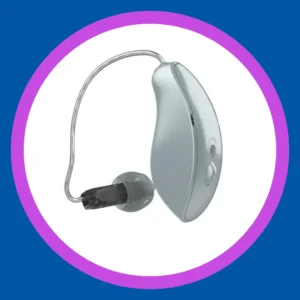
Starkey Omega AI
Omega AI runs Starkey’s G3 platform and is built for people who forget to charge things. The Omega AI 24 reaches up to 51 hours on a full charge, with 48 to 56 hours typical in normal use, and a quick charge of 15 to 30 minutes buys you a usable stretch when you are already late.
Beyond battery, Omega AI brings:
- Twenty-four fine-tuning channels, the most granular adjustment room in our lineup
- Health tracking, including activity monitoring through built-in sensors
- Direct TV streaming with no extra accessory
- Own voice processing, so your own speech stops sounding boomy in your head
- An IP68 rating and 360 degree directionality
- Auracast readiness for venues that broadcast audio
Starkey Edge AI and Genesis AI
Edge AI sits on the earlier G2 Neuro Processor and remains a strong fit, particularly for patients who liked the Edge Mode idea: a tap that reprocesses a difficult moment on demand. Genesis AI, the generation before it, is still in service for plenty of our patients. We fit what suits the ear, not what launched most recently. Our Starkey hearing aids page walks through the family in more detail.
Battery Life, Side by Side
Runtime is the single most common question we get about ReSound vs Starkey hearing aids, and it is one place the two brands separate hard.
| Model | Rechargeable runtime | Quick charge | TV sound |
|---|---|---|---|
| ReSound Sensia 9 | Up to 24 hours | Not published | Through an accessory |
| ReSound Sensia 7 | Up to 24 hours | Not published | Through an accessory |
| Starkey Omega AI 24 | Up to 51 hours | 15 to 30 minutes | Direct from the TV |
Read that table with your own week in mind. Twenty-four hours covers a normal day with room to spare, and it means charging every night without exception. Fifty-one hours means a forgotten night does not end your morning. If you travel, camp, or keep unpredictable hours, that gap is the whole decision.
Streaming, Auracast, and Phone Calls
Both platforms now speak Bluetooth LE Audio and both are Auracast ready, which matters more each year as theaters, airports, and places of worship start broadcasting sound straight to hearing aids. Sensia holds two connections at once and takes calls hands free. Omega AI does the same and adds the direct TV path.
A few practical notes from the fitting room:
- Two active connections is the working limit on both brands, so a phone and a laptop can stay paired while a third device waits
- Hands-free calling means the microphones in your hearing aids pick up your voice, so your phone can stay in your pocket
- Auracast is a venue feature, so its usefulness depends on your venues rather than your devices
If connectivity is your main driver, bring your actual devices to the appointment. We pair them in the room rather than guessing from a spec sheet.
Which Brand Handles a Loud Room Better
Underneath most ReSound vs Starkey hearing aids questions sits this one. A restaurant on a Friday night is the test that sells or sinks a hearing aid.
ReSound’s answer is the neural denoiser. It was trained to pull speech apart from noise and runs on its own chip, so the main processor is not splitting attention. On the Sensia 9 it engages by itself.
Starkey’s answer is directionality plus a manual override. The 360 degree microphone system narrows toward speech, and Edge Mode lets you force a fresh read of a bad room with a tap.
Which wins depends on you:
- If you want the device to decide and you never want to fiddle, Sensia 9 is the better match
- If you like a control you can press when the room turns, Starkey suits you better
- If your hard rooms are predictable, such as the same restaurant every Thursday, either brand can be programmed for it
Worth naming plainly. No hearing aid removes background noise. Both brands reduce it so speech is easier to follow, and the gap between a good fitting and a bad one is wider than the distance between these two brands.
Tinnitus Support on Both Sides
Both platforms in the ReSound vs Starkey hearing aids comparison include tinnitus sound support, and neither is a cure. There is no cure for tinnitus, and there are real ways to manage it and reduce how much it intrudes. Sound therapy delivered through a well fitted hearing aid is one of them, particularly when hearing loss and tinnitus arrive together, which is the common pattern. We talk through the full set of options on our tinnitus treatment options page.

Fit, Size, and Daily Handling
Both brands use a receiver-in-canal design in the models we fit most, and both are small enough to disappear under hair or behind an ear. Sensia’s microRIE housing is the smaller of the two.
Things worth handling before you decide:
- Charger size, since one lives on your nightstand and travels with you
- Button and tap controls, which matter more if dexterity is a concern
- The app on your own phone, because you will use it more than you expect
- Dome or earmold style, which changes comfort more than the device body does
We put both brands in your hands at the appointment. Fifteen minutes of holding them settles questions a page of specifications cannot.
Feature Comparison at a Glance
| Feature | ReSound Sensia | Starkey Omega AI |
|---|---|---|
| Newest platform | Dual chip with neural denoiser | G3 with 360 degree directionality |
| Fine-tuning channels | 17 on the 9, 14 on the 7 | 24 |
| Battery | Up to 24 hours | Up to 51 hours |
| Health tracking | Not included | Activity sensors built in |
| Auracast ready | Yes | Yes |
| Water and dust rating | IP68 | IP68 |
| Single-sided loss | CROS and BiCROS compatible | Handled by a separate Starkey CROS device |
| Manual noise override | Automatic on the 9 | Edge Mode tap |
Best If You: Matching the Brand to Your Life
There is no single best hearing aid, only the one that is best for you. Reading a ReSound vs Starkey hearing aids comparison will never tell you which ear you have, and twenty-plus years of fittings teaches that the ear decides.
- Best if you eat out constantly and hate fiddling: ReSound Sensia 9, which reads the room and shifts on its own
- Best if you want the newest noise engineering at a gentler tier: ReSound Sensia 7, same denoiser, your finger on the switch
- Best if you forget chargers or travel often: Starkey Omega AI, where a missed night is survivable
- Best if you track your steps and your health already: Starkey Omega AI, with sensors in the device
- Best if you watch a lot of television: Starkey Omega AI streams directly, while ReSound routes through an accessory
- Best if you have hearing in only one ear: ReSound Sensia, which is CROS and BiCROS compatible across both tiers
Only about one in five people who would benefit from a hearing aid wears one, according to the National Institute on Deafness and Other Communication Disorders. A brand name on the box is rarely what keeps the other four away. Fitting, follow-up, and having somewhere local to walk into are what keep a device in an ear.
Why Choose Stanford Hearing, and What to Do Next
We are locally owned, with 20-plus years of trusted care in Sioux Falls and Buffalo, and voted Sioux Falls Local Best 20 years. We carry five premium hearing aid brands and recommend based on your hearing, your lifestyle, and the places you most want to hear well. Because we are brand neutral, comparing ReSound vs Starkey hearing aids with us is a conversation rather than a sales pitch.
Here is what that looks like in practice:
- Free consultations with no pressure to buy, so your first appointment costs you nothing but an hour
- A 10-day trial so you can wear your hearing aids in real life before you decide, and if they are not right, return them within the 10 days for a full refund
- A price match guarantee, so you will not overpay locally. If a nearby clinic beats our price on a comparable device, we meet it
- 12 months no-interest financing, subject to credit approval
- In-network with all major insurance providers, including Medicare Advantage, and we verify your benefits before your appointment
- Two clinics, Sioux Falls and Buffalo, with the same team before and after the sale
Bring your questions and your phone. Schedule a free consultation and we will test your hearing, show you both brands, and let your ears settle the argument. Our hearing evaluation process starts there, because a recommendation without an audiogram is a guess.
Common Questions About ReSound vs Starkey Hearing Aids
Which is better in noisy restaurants, ReSound or Starkey?
Both handle noise well by different routes. ReSound Sensia runs a dedicated neural denoiser that separates speech from background sound, and on the Sensia 9 it engages automatically. Starkey uses 360 degree directional microphones plus Edge Mode, a tap that reprocesses a difficult moment on demand. At Stanford Hearing we let you hear both in our fitting room before you commit to either.
Do ReSound and Starkey hearing aids work with an iPhone and an Android phone?
Yes, both platforms pair with Apple and Android devices and both support hands-free calling. Each holds two active connections at once. Bring your own phone to your appointment at Stanford Hearing and we will pair it in the room rather than promising it works and hoping.
Can I try both brands before buying?
Yes. Every purchase from Stanford Hearing includes a 10-day trial so you can wear your hearing aids at home, at work, and out with people before you decide. If they are not right for you, return them within the 10 days for a full refund.
Which brand is better for tinnitus?
Tinnitus support ships on both sides of the ReSound vs Starkey hearing aids question, and neither brand cures tinnitus. What helps most is a device programmed to your hearing loss along with strategies a hearing care provider walks you through. Our team in Sioux Falls and Buffalo handles both parts of that in the same appointment.
Does insurance cover ReSound or Starkey hearing aids?
Original Medicare does not cover hearing aids, and many Medicare Advantage plans include a hearing benefit, with coverage varying by plan. Stanford Hearing is in-network with all major insurance providers, and we verify your benefits before your appointment so you know what is covered before you commit.
How do I know which one is right for my hearing?
Your audiogram decides more than any ReSound vs Starkey hearing aids comparison can. Degree of loss, the shape of that loss across frequencies, and the rooms you spend your life in all narrow the field quickly. Book a free consultation with Stanford Hearing and we will map it out with you.