
Choosing a Hearing Aid Technology Level
Updated July 2026 · By Dr. Jade Husby, Au.D.
Short Version: A hearing aid technology level sets how much processing power sits inside the device. The tiers run Premium, Advanced, Standard, and Essential. Higher tiers handle noise and busy rooms better. Lower tiers suit quieter, simpler days. Your listening life and your degree of loss point to the right one. A precise fitting matters even more. We help you choose a hearing aid technology level in Sioux Falls and Buffalo.
Shopping for hearing aids gets confusing fast. Choosing a hearing aid technology level is where most of that confusion lives. Every brand sells one device in several tiers, and the labels rarely explain the difference. This guide breaks down each level in plain language. By the end, you will know which one fits your days and your hearing.
What a Hearing Aid Technology Level Means
A technology level does not change how a device looks. Nor does it change how the device sits in your ear. What it changes is the processing power inside the shell. Picture two cars with the same body but different engines. The stronger engine does more, faster, with less strain. That power costs more, which is why the tiers exist. Makers price each level to match how hard it works. A higher hearing aid technology level means faster, finer sound decisions. That speed is what you notice most in a busy room.
A hearing aid technology level shapes a handful of everyday things:
- How quickly the device adjusts as you change rooms
- How sharply it reduces background noise
- How many listening programs and settings it offers
- How well it streams from phones and TVs
- How naturally it handles many voices at once
Each of those improves as you climb the tiers. The chart below shows how far each level reaches.
The Four Levels and What They Cover
Most manufacturers group devices into four tiers. Our chart maps each hearing aid technology level to the situations it handles well. Find the row that sounds most like your week.
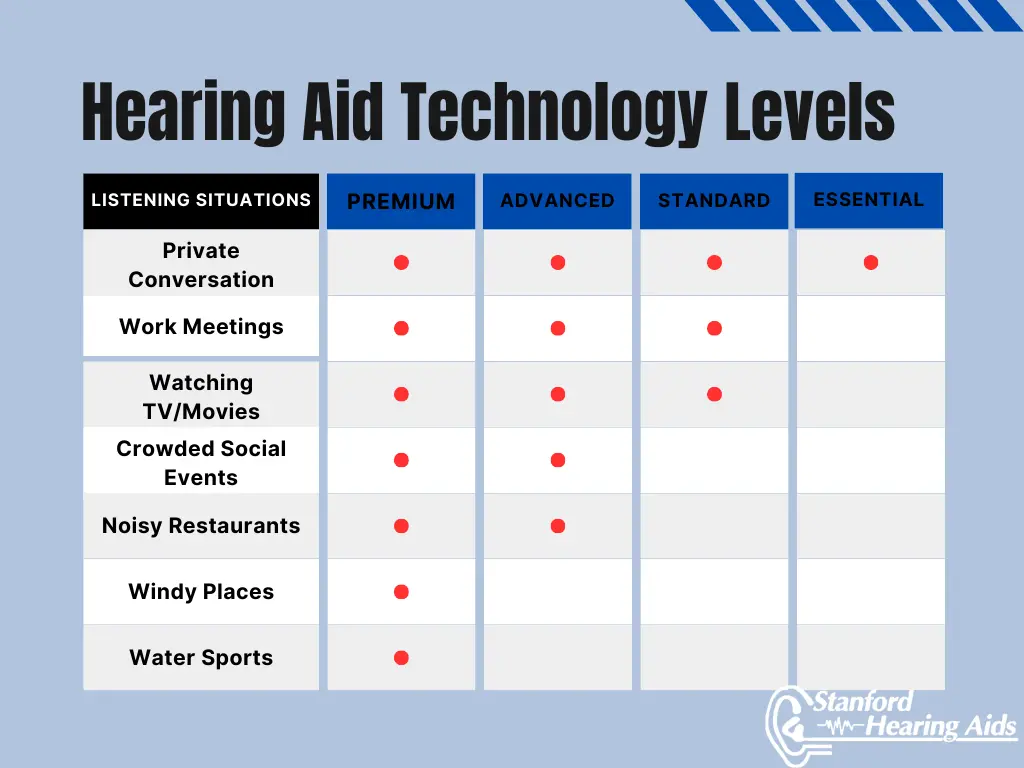
What the Chart Looks Like in a Noisy Restaurant
Picture the same crowded restaurant at each level. The scene makes the chart concrete. Nothing shows the gap between tiers like real background noise.
- Essential and Standard get overwhelmed by the clatter
- Advanced starts to track your table over the din
- Premium locks onto one voice as it moves across the table
The jump you feel depends on how loud your life gets. A quiet diner may never notice the top tier. Frequent diners will feel it by the entrée.
Match Your Listening Life to a Level
Your calendar tells the truth about which tier earns its price. A person who dines out four nights a week needs more. Someone who reads at home in quiet needs less. Map your real week against the chart above.
- Loud, varied days in crowds point toward Premium
- A busy mix of settings fits Advanced well
- Meetings and TV in mostly calm rooms suit Standard
- Home-centered, one-on-one days pair with Essential
Match your honest routine, not your ideal one. That is how you get real value. Take a retired teacher who golfs and hosts big dinners. Her windy course and loud kitchen point straight to Premium. A neighbor who mostly reads may thrive on Essential. If your days span many settings, explore types of hearing aids for every lifestyle first.
One situation deserves special mention. Following one voice across a loud table is the hardest job any device performs. Premium and Advanced tiers pull ahead most in that moment. That is why hearing speech in noise is the clearest test of any technology level.
How Your Hearing Loss Shapes the Right Technology Level
The chart assumes we know your hearing. That knowledge comes only from testing. Your audiogram shapes both the device style and the tier. A steep or complex loss asks more of the processor. Gentle, even losses can sound great on a modest tier. The shape of your loss counts as much as the depth.
Here is how degree of loss tends to guide the choice:
| Degree of loss | What it means day to day | Level to consider |
|---|---|---|
| Mild | Missing soft speech and consonants | Essential to Advanced |
| Moderate | Struggling in groups and noise | Standard to Premium |
| Severe | Difficulty even in quiet talk | Advanced to Premium |
| Profound | Reliant on strong, precise power | Premium, professionally fit |
Store-bought options carry real limits here. The FDA limits over-the-counter devices to mild to moderate loss. It warns against them for severe or profound cases. A proper exam removes the guesswork. Start with comprehensive hearing tests before you spend a dollar.

Where the Five Brands We Carry Fit In
Every major manufacturer builds this same tier structure into its lineup. A Premium Phonak and a Premium ReSound both sit near the top. Essential options sit further down each platform. We stay brand-neutral and fit the device to you. No single brand wins for everyone, and we never pretend otherwise. The best maker is the one that fits your ears and your life.
- Phonak leads with speech clarity in loud, social settings
- ReSound leans into small size, streaming, and connectivity
- Starkey builds health tracking in alongside strong sound
- Unitron offers flexible trial and upgrade paths
- Oticon focuses on natural, brain-first sound processing
Each brand carries several tiers. The same name can suit a quiet retiree or a busy professional. Comparing across all five gets easier from one place. Begin with the hearing aid brands we carry. We weigh them for you without a sales agenda.
Common Mistakes When Choosing a Technology Level
A few missteps show up again and again in our exam rooms. Spot them now and you will shop smarter. Most of them cost money without buying better hearing.
- Buying the top tier for a mostly quiet life
- Choosing by brand name instead of your listening needs
- Ignoring your audiogram and guessing at your loss
- Skipping the trial period and hoping for the best
- Paying for streaming features you will never touch
Avoid these and your money follows your ears. Each mistake traces back to comparing specs without comparing your life.
Do You Need the Top Level
Premium tiers grab attention, and the marketing is loud. Many people hear beautifully on a lower tier though. The right question is not which level is best overall. It is which level is best for you.
- Ask how often you sit in real background noise
- Ask how much you stream calls, music, and TV
- Ask whether your loss is mild, moderate, or greater
- Ask what your budget allows without strain
Answer those plainly and the tier often picks itself. This quick head-to-head shows the real trade-offs:
| Where it counts | Essential | Premium |
|---|---|---|
| Noisy rooms | Basic help | Strong, automatic focus |
| Streaming | Limited | Rich and hands-free |
| Auto adjustment | Mostly manual | Instant and automatic |
| Cost | Lower | Higher |
| Best for | Quiet routines | Busy, varied days |
The chart guides the head. Your daily life guides the gut. We help you match both.
Why Fitting Matters More Than the Level
Here is the part no chart can show you. A Standard device fit well beats a Premium device fit poorly. The processor only performs when it matches your hearing.
A hearing care provider fits each prescription device to your degree of loss. We then fine-tune it over follow-up visits. That tuning is where clarity is won or lost.
Our process protects your investment at every step:
- We test your hearing and map your exact loss
- We match the tier to your life and audiogram
- We program the device to your prescription
- We adjust the fit and settings over follow-up visits
- We keep tuning as your hearing changes
That hands-on care turns a good device into the right one. See how professional hearing aid fittings work before you commit.
What About Your Budget
Higher tiers cost more, and that reality shapes many choices. A well-fit lower tier can still outperform a poorly chosen Premium one. You are buying clarity that fits your days, not bragging rights. Real value comes from a level you will use every day. Overbuying helps no one but the marketing budget.
- Start with the tier your life and hearing call for
- Skip features you will never use in a real week
- Ask about no-interest financing to spread the cost
- Use our price match guarantee on comparable devices
- Verify your insurance benefits before you assume anything
Spending smart beats spending big when the fit is right. For more, read our guide to budget hearing aids.
How Long Should a Technology Level Last You
A good hearing aid is a multi-year commitment, so think ahead. Your hearing can shift over that span, and your life can change too. The right tier leaves a little room to grow.
- Pick a tier that fits today and the next few years
- Favor a level that streams if your devices keep multiplying
- Choose room to adjust as your hearing changes
- Lean on follow-up care to keep the fit current
Buying only for today can mean upgrading sooner than you hoped. Regular check-ins keep your device tuned as life shifts. Small adjustments protect the value of the level you chose. A short conversation with us maps the smarter horizon.
Why Choose Stanford Hearing to Choose Your Level
Ready to hear better with confidence? A chart gets you started. Then a hearing care provider who listens gets you the rest of the way. We have served Sioux Falls and Buffalo for more than 20 years. As a locally owned practice, we treat neighbors like neighbors.
Here is what you get when you choose a level with us:
- A free consultation with no pressure and no script
- A 10-day trial to feel the difference before you buy
- Five premium brands, compared side by side for you
- A price match guarantee on comparable devices
- No-interest financing to fit the plan to your budget
- In-network insurance with full benefit verification
Options for every budget sit within reach at both clinics. Schedule a free consultation and let us match the right level to your life.
About the Author
Dr. Jade Husby, Au.D., is the owner and president of Stanford Hearing. She earned her Doctor of Audiology from the University of South Dakota. Her training also includes a residency in ENT. Today she leads patient care across our Sioux Falls and Buffalo clinics.
Choosing a Hearing Aid Technology Level: Common Questions
Does a higher hearing aid technology level always mean better hearing?
No, and this trips up many first-time buyers. A Premium device fit poorly serves you worse than a Standard device fit well. At Stanford Hearing, we match the level to your hearing and your life. Then we program it precisely, so you never pay for power you will not use.
Can I change technology levels after I buy at Stanford Hearing?
The technology level lives inside the device, so you cannot upgrade it like an app. That is why the choice matters up front. Our 10-day trial lets you test a level in your real world. We help you adjust before the trial ends if it feels wrong.
How do I learn my degree of hearing loss before I choose a level?
A chart cannot read your ears, but a hearing exam can. We test your hearing at our Sioux Falls and Buffalo clinics. Then we walk you through the results in plain language. That audiogram is the foundation for every level we recommend.
Are Premium hearing aids worth it for a quiet lifestyle?
Often they are not, and we will tell you so. An Essential or Standard device may serve a calm, quiet routine beautifully. Stanford Hearing recommends the level your life needs. We never push the priciest option on the shelf.
Which brands can I compare across technology levels at Stanford Hearing?
We carry Phonak, ReSound, Starkey, Oticon, and Unitron, and each offers several tiers. That range lets us compare devices across brands and levels in one visit. We stay brand-neutral at Stanford Hearing. The recommendation always follows your hearing and your budget.
Will my insurance cover a higher hearing aid technology level at Stanford Hearing?
Coverage varies by plan, and the level you choose can affect your share. Some benefits apply a fixed allowance across every tier. At Stanford Hearing, we verify your benefits up front. Then we show you the real cost of each level. That way no surprise lands after you decide.