Unleash Your Ears: The Best Hearing Aids with Bluetooth
Updated September 2026 · Dr. Jade Husby, Au.D.
Short Version
Hearing aids with Bluetooth have moved past streaming your phone. LE Audio and Auracast let a venue broadcast sound your devices receive directly, with no neck loop and nothing to borrow at a desk. Most current platforms we fit support it. Whether it helps you depends on where you spend your time.
For most of the last decade, Bluetooth in a hearing aid meant one thing: your phone. That was useful and it was also a small idea, because a phone is one device in one pocket and the places people struggle to hear are airports, theaters, gyms and church halls. The newest hearing aids with Bluetooth are built around a different standard, and the difference is not incremental. Here is what changed, which devices carry it, and how to judge whether it matters for the way you live.
If your question is which specific device to buy rather than which standard to care about, our roundup of the best Bluetooth options answers that directly.
What LE Audio Solved for Hearing Aids with Bluetooth
The older Bluetooth standard was designed for headphones, and hearing aids borrowed it. That created three problems nobody had set out to cause: it drained batteries faster than a tiny device could afford, it made a single audio stream difficult to send to two separate ears, and it had no way to serve a room full of listeners at once.
LE Audio was built to fix all three, and the third fix is the one with the largest consequences:
- Lower power draw, so streaming costs less battery than it used to on the same size cell.
- A stream designed for two ears rather than one, which is what makes stereo calling work properly.
- Broadcast, meaning one transmitter can serve unlimited receivers, which is the foundation Auracast is built on.
Those three together are why current hearing aids with Bluetooth behave differently from a set bought five years ago.
Auracast and the End of the Neck Loop
Bluetooth SIG describes Auracast broadcast audio as a capability positioned to become an advanced assistive listening system, one that is easier and cheaper for venues to deploy while offering higher audio quality and greater privacy than what they run today. It also names the case people notice first: televisions in public spaces, unmuting what was once silent.
The practical shape of it is simple. A venue broadcasts, you select the broadcast, and the sound arrives in your ears. No neck loop draped over your coat, no borrowed receiver from a desk, no telling a stranger you cannot hear.
Where we expect our patients to meet it first:
- Airports. Gate announcements are the classic case, and the one that costs people flights.
- Theaters and cinemas. Replacing the assistive headset nobody wants to wear.
- Houses of worship. Where loop systems already exist and will be replaced over time.
- Gyms and waiting rooms. The silent televisions everyone squints at.
- Lecture halls and meeting rooms. Where a single presenter is the whole point.
Rollout is the limiting factor rather than the devices, and hearing aids stay in service long enough that this is worth buying toward.
Which Devices Carry It
Support is not uniform across the lineup, and the differences are worth reading before you decide.

| Device | Auracast and LE Audio | Connections | Battery |
|---|---|---|---|
| Phonak Audeo EON Sphere | Auracast and LE Audio | 8 pairings, 2 active | Up to 38 hours |
| Phonak Audeo EON R | Auracast ready | 8 pairings, 2 active | Up to 38 hours |
| ReSound Sensia | Auracast and LE Audio | 2 simultaneous | Up to 24 hours, 12 to 24 streaming |
| ReSound Nexia | Auracast | Direct streaming | Up to 30 hours |
| Starkey Omega AI 24 | Auracast ready | Direct TV streaming | Up to 51 hours |
| Phonak Virto R Infinio | Bluetooth, custom in-the-ear shell | 8 pairings, 2 active | Charges fully in 3 hours |
Read “Auracast ready” as a real distinction rather than marketing softness. It means the hardware supports the standard and the experience depends on venues and on firmware, which is a different promise from a feature working today.
Hands-Free Calling Is the Everyday Win
Auracast is the headline, and hands-free calling is what most owners of hearing aids with Bluetooth use daily. Both current Phonak families support stereo hands-free calling through DuoPhone, so the caller hears you through the hearing aid microphones while you hear them in both ears. Sensia supports hands-free calls too, alongside tap control on the ear.
Three practical notes we give at every fitting:
- Two active connections is the cap. A phone and a laptop, not a phone, a laptop and a tablet. Connecting a third quietly drops one.
- Your own voice arrives differently at first. Give it a week, then tell us if it has not settled.
- Wind ruins a call faster than a restaurant does. Phonak’s EON R carries WindBlock 2.0 if you are outdoors a lot.
Bring your phone to your appointment and we pair it there, which turns a specification into something you can hear.
Television, Which Is Still Not Solved the Same Way Twice
Every household asks about the television, and among hearing aids with Bluetooth the answer splits by device. Starkey’s Omega AI 24 streams from a television directly. ReSound Sensia routes television sound through a small transmitter that plugs into the set.
The accessory sounds like the weaker option and often is not, because it works with older sets that have no useful Bluetooth of their own, which describes most living rooms. Tell us what television you own before you choose a platform on this basis.
What Bluetooth Costs You
Nothing here is free, and hearing aids with Bluetooth carry three trade-offs worth knowing before you buy.
- Battery. Streaming draws more. ReSound publishes Sensia at 12 to 24 hours when streaming against 16 to 24 in normal use, which is the honest version of a headline figure.
- Complexity. Every connected device is one more thing that can drop, update or misbehave.
- The telecoil trade. Several current platforms dropped the telecoil in favor of Auracast. ReSound Sensia, Vivia and Nexia carry no telecoil, and Phonak’s Virto custom line offers one only as an option specified at order.
That last one is the trade that catches people. If your church runs a loop today and the venue has no plan to change it, say so before we order anything.
Custom Devices and the Antenna Problem
Hearing aids with Bluetooth are not all worn behind the ear. Phonak’s Virto R Infinio is a custom in-the-ear device that pairs with up to eight devices and holds two connected, with one-step pairing to the myPhonak app. Its 10 NW O sibling is the non-wireless option and pairs with nothing at all, which suits patients who want none of this.
One physical limit applies to any custom device: the antenna sits inside your ear canal rather than outside your ear, so range and line of sight matter more. In practice that means keeping your phone in a front pocket rather than a back one, and it is a small habit rather than a reason to rule the shape out.
The Accessory That Beats Every Bluetooth Feature
Here is something no manufacturer leads with. In a car, in a noisy restaurant, or across a conference table, a remote microphone clipped to the person you want to hear will outperform every processing feature in the device. Distance is the enemy, and a microphone that closes the distance solves what algorithms only soften.
Where accessories still earn their place alongside hearing aids with Bluetooth:
- Remote microphones. Clip one to a spouse in the passenger seat and a car stops being the worst room in your life.
- Assistive microphone systems. Phonak’s EON R carries RogerDirect, which receives from Roger transmitters without a separate receiver hanging off the device.
- Television transmitters. ReSound Sensia uses one, and it handles older sets that direct streaming cannot reach.
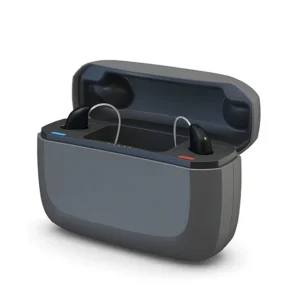
- Charging cases with a battery inside. Worth having if you travel, because a dead charger is a dead pair of hearing aids.
We would rather send someone home with a modest device and the right accessory than a premium device and nothing to close the distance.
Choosing by How You Connect
Feature parity across hearing aids with Bluetooth is closer than it has ever been, so the sorting comes down to your own week.
- Best if venues are your struggle. A platform with full Auracast and LE Audio support, such as the Phonak Audeo EON Sphere or ReSound Sensia.
- Best if the television is the main event. Starkey Omega AI 24 for a modern set, or ReSound Sensia with its accessory for an older one.
- Best if you are on calls all day. Long battery and a published streaming figure, so you know your margin.
- Best if you work outdoors or on the move. Phonak EON R, for wind handling and RogerDirect.
- Best if you want none of it visible. Phonak Virto R Infinio, with Bluetooth in a custom shell.
- Best if one ear has no usable hearing. Phonak EON R 90 with a CROS device, or ReSound Sensia.
None of that settles until you have worn the device in your own life, which is what the trial exists for.
Connectivity Is Not a Substitute for Fit
Hearing aids with Bluetooth that stream flawlessly and are programmed to a generic curve will still leave you struggling at a dinner table. Every feature above sits on top of amplification that either matches your hearing or does not, and matching it is measurement rather than guesswork.
We start with a full hearing evaluation, then use live speech mapping to confirm the device is hitting target inside your ear canal. After that, connection problems are the easy part, and we sort those at follow-up visits rather than leaving you on a support line.
Why Choose Stanford Hearing and What to Do Next
We have been locally owned in Sioux Falls for 20-plus years, and we are a consistent Sioux Falls Local Best winner. We carry five premium hearing aid brands, Phonak, ReSound, Starkey, Unitron and Oticon, and recommend based on your hearing, your lifestyle, and the places you most want to hear well. There is no single best hearing aid, only the one that is best for you.
Free consultations come with no pressure to buy. Your first appointment is a complimentary assessment of your hearing and your needs, with no obligation. Every purchase includes a 10-day trial so you can wear your hearing aids in real life before you decide, and if they are not right for you, return them within the 10 days for a full refund. A price match guarantee means you will not overpay locally, and if a nearby clinic beats our price on a comparable device, we meet it. 12 months no-interest financing spreads the cost into monthly payments for qualifying patients, subject to credit approval. We are in-network with all major insurance providers, including Medicare Advantage, and we verify your benefits before your appointment so you know what is covered before you commit.
You will find us in Sioux Falls, South Dakota and Buffalo, Minnesota, and we serve surrounding communities across the region. Schedule a free consultation and bring the phone, the tablet and a photo of the back of your television.
Your Questions About Hearing Aids with Bluetooth, Answered
Do I need Auracast right now?
You need it soon rather than today, and that is the honest framing. Venue rollout is ongoing while hearing aids stay in service for years, so a device without it ages out of a capability. At Stanford Hearing we will ask which specific venues you struggle in and tell you whether Auracast helps there or whether something else does more.
Will hearing aids with Bluetooth work with my phone?
The current platforms we fit work with both iPhone and Android, which was not true a few years ago. What varies is which features carry across, particularly hands-free calling. Bring your own phone to your appointment with us and we will pair it in the room rather than promising it and finding out afterward.
Can I connect to more than two devices?
You can pair many and connect two. Phonak’s Audeo EON Sphere pairs with eight devices and holds two active, and ReSound Sensia holds two simultaneous connections. Connecting a third drops one of the others, which is behind most of the connection complaints we hear. We will set your two priority devices at the fitting.
Does streaming wear the battery out faster?
It uses more power in a day, and it does not shorten the life of the battery itself. ReSound publishes Sensia at 12 to 24 hours when streaming, and the Phonak Audeo EON families at up to 38 hours. If you stream several hours daily, tell us and we will weigh you toward the platforms with the most headroom.
What happened to telecoils?
Several current platforms dropped them for Auracast. ReSound Sensia, Vivia and Nexia carry no telecoil, and Phonak’s Virto custom line offers one as an option that has to be specified when the device is ordered. If you use a loop system today, tell us before we order, because this cannot be added afterward.
What if I want a hearing aid that connects to nothing?
That is a legitimate choice and we fit it. Phonak’s Virto I-10 NW O is a non-wireless custom device with no pairing at all. Plenty of our patients want better hearing without another thing to manage, and nobody at Stanford Hearing will talk you into features you have no use for.