
Understanding the Parts of a Hearing Aid: What Every Component Does
Updated June 2026
Most people put on a hearing aid without thinking about what is inside. Yet knowing the parts of a hearing aid can change your whole experience. You communicate better with your provider, catch small problems early, and choose with confidence. This guide walks through each component in plain language. It also shows how we fit, service, and repair them for you.
How Sound Travels Through a Hearing Aid
Before the individual parts, it helps to see the big picture. Sound enters through the microphone and becomes a digital signal. A processor shapes that signal to match your hearing prescription. The receiver then delivers it into your ear, all in milliseconds.
Federal hearing experts describe how the microphone, amplifier, and speaker work together. Those are the three core parts of a hearing aid. Every part along that path matters. A weak link in any one affects the whole experience. Our guide to how hearing aids work covers the full process.
Here is the signal path at a glance:
- The microphone captures sound from your surroundings.
- The processor cleans and customizes that sound.
- The receiver sends the finished sound into your ear.
These three steps repeat thousands of times each second. The other parts of a hearing aid support and protect that core chain.
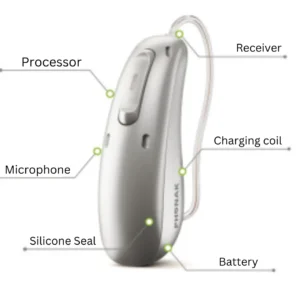
The Microphone: Where Sound Begins
The microphone is the hearing aid’s first contact with the world. It picks up sound waves and turns them into electrical signals. The processor then has something to work with.
Omnidirectional and Directional Microphones
Basic microphones pick up sound equally from every direction. That works fine in a quiet room. Busy places are harder, and that is where directional microphones help. They focus on sound from in front of you, usually your conversation partner.
A few points worth knowing about microphone modes:
- Omnidirectional mode keeps you aware of your surroundings.
- Directional mode sharpens speech in noisy rooms.
- Most modern aids switch between them automatically.
One peer-reviewed study found that directional microphones improve speech understanding in noise for older adults. That benefit is a big reason fittings matter so much.
Newer Microphone Technology
Today’s microphones go beyond simple direction. Some sit inside the ear canal to use your outer ear’s natural shape. Others use machine learning to track speech from any angle. The result is more natural, more spatial sound.
The Processor: The Brain of the Device
If the microphone is the ear, the processor is the brain. It is one of the most vital parts of a hearing aid. This tiny chip turns raw sound into something useful. It applies your prescription thousands of times each second.
Feedback Cancellation
Older aids were known for a high-pitched whistle. That sound is feedback, leaking from the receiver back to the microphone. Modern processors catch and cancel it before you hear it. Most wearers today never notice feedback at all.
Noise Reduction
Early noise reduction simply turned everything down at once. Today’s processors are far more precise. They separate speech from noise and trim the noise selectively. That cut in background sound reduces listening fatigue across a long day.
AI and Deep Neural Networks
The biggest recent leap is artificial intelligence. Some processors use deep neural networks trained on millions of sound scenes. They recognize patterns rather than follow simple rules. For more on this shift, see our look at the latest hearing aid technology.
The Receiver: Delivering Sound to Your Ear
The receiver, sometimes called the speaker, is the final step. It turns the processed signal back into sound waves. Those waves travel into your ear canal.
Why Placement Matters
Older designs kept the receiver inside the housing behind the ear. Most modern aids use a receiver-in-canal design instead. The receiver sits in the canal on a thin wire. That placement improves clarity and allows a more discreet fit.
Receiver Power Levels
Receivers come in different power levels for different needs. A standard receiver suits mild to moderate hearing loss. Greater loss needs a more powerful receiver to avoid distortion. Your provider matches the receiver to your audiogram during the fitting.
The Power Source: Keeping Everything Running
Every part of a hearing aid depends on steady power. Two main options exist today, each with clear trade-offs. The right choice depends on your routine and dexterity.
Here is how the two power sources compare:
| Feature | Disposable Batteries | Rechargeable Lithium-Ion |
|---|---|---|
| Power per charge or set | 3 to 10 days, size dependent | Up to 30 or more hours per charge |
| Convenience | Carry spare batteries | Charge overnight like a phone |
| Cost over time | Ongoing battery purchases | Higher upfront, lower ongoing |
| Dexterity needed | Yes, batteries are small | Minimal, just dock and go |
Rechargeable aids are now the popular choice for most patients. A short charge can give you several hours of use. That helps on mornings when you forget to charge overnight.
The Charging Coil and Telecoil
The charging coil can serve two roles. In rechargeable models, it draws power from the case without pins or ports. You set the aid in its case and charging starts on its own.
Many aids also include a telecoil for public spaces. It picks up sound from loop systems in theaters, churches, and airports. The telecoil filters out room noise and delivers cleaner audio. It can also sharpen phone calls on compatible handsets.
Protection and Fit: Seals, Domes, and Earmolds
The parts of a hearing aid only help if they stay protected and fit well. Two quiet features handle that job behind the scenes. Both extend the life of your device.
The Silicone Seal and Wax Guards
A silicone seal wraps the key components inside the housing. It blocks moisture, sweat, and dust from the electronics. Most current aids carry an IP68 water and dust rating. Wax guards add another layer of protection. Our tips on how to clean your hearing aids keep them working.
Domes and Earmolds
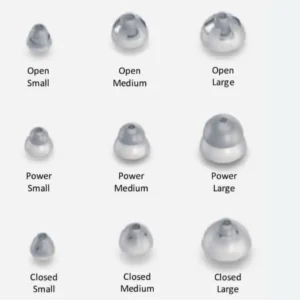
Domes and earmolds connect the receiver to your ear canal. Their fit decides how well sound reaches you.
How the two coupling options compare:
| Option | Best For | Key Benefit |
|---|---|---|
| Domes | Mild to moderate loss | Quick, comfortable, easy to change |
| Closed or power domes | More significant loss | A tighter seal for more power |
| Custom earmolds | Severe loss or tricky canals | Precise fit and strong retention |
Choosing the right style matters more than many people expect. Our guide to selecting the right hearing aid domes breaks down the options.
Controls and Extra Features
Beyond the core parts of a hearing aid, a few features put you in control. They make daily use simpler and more comfortable.
User Controls
Modern aids offer controls from on-device buttons to phone apps. Common options give you real flexibility:
- Volume adjustment without a trip to the office.
- Program switching for restaurant, quiet, or outdoor modes.
- A focus mode that narrows in on the person ahead.
- App control of treble, bass, and remote provider tweaks.
Together these controls hand you meaningful day-to-day management. You stay comfortable as your surroundings change.
Built-In Tinnitus Masking
Many aids now include tinnitus management built in. They play low-level sounds like soft tones or gentle noise. The goal is to ease the focus on tinnitus, never to cure it. For a fuller plan, we offer tinnitus management options in person.
What Advanced Technology Means for You
The parts of a hearing aid have always shared one purpose. What changed is how smartly each one now performs. Research has linked advanced hearing aid technology to better quality of life. The gains go beyond better hearing.
A few of those everyday gains:
- Smarter processors make cleaner noise decisions.
- Directional microphones track speech from any angle.
- Rechargeable power lasts through a full day.
None of that reaches its potential without proper fitting. A device dialed to your exact ears performs far better. Closing that gap is exactly what we do.
How We Fit, Service, and Repair These Parts in Sioux Falls and Buffalo
Knowing the parts of a hearing aid is step one. Getting them working together for your ears is where we come in. In our Sioux Falls and Buffalo clinics, we handle the whole device. We work across all five brands we carry.
Here is how we support each part over time:
| Part | Common Issue | How We Help |
|---|---|---|
| Microphone | Clogged with debris | Cleaning and filter changes |
| Receiver | Weak or muffled sound | Replacement without a new device |
| Wax guard and dome | Sound drops off | Quick swaps in the office |
| Battery or charger | Short runtime | Testing and replacement |
| Whole device | Drift from your prescription | Refitting and reprogramming |
We start every device with professional hearing aid fittings. When something goes wrong, we offer hearing aid repair and maintenance on site. We fit the five brands we carry. So we match each part to your exact model. That local support is what a national reference page cannot give you.
Why Choose Stanford Hearing
You do not have to sort out the parts of a hearing aid alone. We have served Sioux Falls and Buffalo for over 20 years, locally owned throughout. Our team explains every part and fine-tunes it until it feels right. Ready to hear better with confidence?
When you visit us, you get:
- A free consultation with a hearing care provider who listens.
- A 10-day trial, so you can try before you commit.
- Five premium brands, matched to your needs, not a sales quota.
- A price match guarantee on comparable devices.
- No-interest financing to ease the cost.
- In-network insurance, including Medicare Advantage, with benefit verification.
- Two convenient locations, our Sioux Falls hearing center and our Buffalo hearing center.
Take the next step today and schedule a free consultation. We will help you protect your hearing and your peace of mind.
About the Author
Dr. Jade Husby, Au.D., is the Owner and President of Stanford Hearing. She earned her Doctor of Audiology at the University of South Dakota. Her training also included an ENT residency. For years, she has cared for patients across Sioux Falls and Buffalo. You can meet our Sioux Falls hearing care team to learn more about her background.
Common Questions About the Parts of a Hearing Aid
What Is the Most Important Part of a Hearing Aid?
Every part plays a role, yet the processor is often the core. It shapes, cleans, and customizes sound to your prescription. Great microphones and receivers still depend on it. Stanford Hearing programs that processor to fit your exact hearing.
Can Water Damage the Parts of a Hearing Aid?
It can, though most modern aids resist sweat and splashes well. Many carry an IP68 rating against moisture and dust. They are not built for swimming, so dry them if soaked. Stanford Hearing can check for moisture damage during a visit.
What Does the Telecoil Do?
The telecoil picks up sound from loop systems in public venues. It filters out room noise for cleaner audio in those spaces. That also improves clarity on compatible phones. Stanford Hearing can tell you which models include one.
How Long Do the Parts of a Hearing Aid Last?
Most hearing aids last five to seven years with good care. Small parts like wax guards and domes need regular swaps. Receivers can sometimes be replaced on their own. Stanford Hearing helps you plan upkeep and timely upgrades.
Can You Repair One Part, or Do I Need a New Device?
Often we can fix or replace a single part. A new receiver, dome, or wax guard may be all it takes. We always try the smaller repair first. Stanford Hearing handles these fixes for the brands we carry.