
Hearing Aid Innovation: Keeping Up with the Latest Technology Trends
Updated September 2026 · Dr. Jade Husby, Au.D.
Short Version
Three hearing aid technology trends matter right now: a second chip devoted to separating speech from noise, Bluetooth LE Audio with Auracast for venue broadcasts, and batteries that outlast a long day. Everything else is refinement. The fitting still decides more than any of it.
Hearing aid technology moves in bursts, and August 2026 was one of them. Both Phonak and ReSound launched new platforms within a week of each other, which is unusual, and it means the hearing aid technology trends we discuss with patients today are different from the ones we discussed in spring. Part of what changed is substantial. The rest is specification that reads well and changes little in a real living room. Here is our plain sorting of the two, from a clinic that fits all of it.
Trend One: A Second Chip Just for Noise
Of the hearing aid technology trends on this page, this is the one with the most engineering behind it, and the change is architectural. Rather than asking one processor to handle everything, manufacturers started adding a second chip whose only job is separating speech from background sound.
Phonak’s Audeo EON Sphere, in the 90 and 70 tiers, pairs the ERA chip with a second chip called HYPERSONIC. ERA runs processing and connectivity, HYPERSONIC runs real-time AI sound work, and Spheric Speech Clarity 3.0 lives on the second chip. ReSound’s Sensia, in the 9 and 7 tiers, uses a dual chip design with a deep neural network denoiser working alongside the main processor.
Why the split matters:
- A single processor splitting attention between streaming, classification and noise reduction does all three less well
- A dedicated chip can run a heavier algorithm continuously without draining the device
- The gain shows up exactly where patients struggle, which is a busy restaurant rather than a quiet room
One caveat. No hearing aid removes background noise, and both of these reduce it so speech is easier to follow. If someone promises silence, walk away.
Trend Two: Bluetooth Grew Up
Connectivity used to mean pairing to one phone and hoping. Three things changed it.
| Change | What it does | Whether it matters to you |
|---|---|---|
| Bluetooth LE Audio | A more efficient standard built for hearing devices | Yes, quietly. Better sound, less battery drain |
| Auracast broadcast | Venues transmit sound to any listening device in range | Only if your venues have it, and coverage is spreading |
| Multiple connections | Two devices live at once, and Phonak remembers eight | Yes, if you juggle a phone, a tablet and a television |
Auracast is the one worth watching. A looped venue used to need a telecoil in your hearing aid. An Auracast venue broadcasts, and any capable device in the room can tune in, the way a radio does. Airports, theaters, gyms and places of worship are adopting it at their own pace, which means its value to you is local rather than universal.
Every current platform we fit is Auracast capable. ReSound got there first with Nexia, and the rest of the industry followed.
Trend Three: Batteries That Outlast the Day
Rechargeable stopped being a premium feature and became the default, and the figures have stretched.
- Phonak’s EON platforms reach up to 38 hours per charge
- ReSound Sensia reaches up to 24 hours, with 16 to 24 typical and 12 to 24 when you stream heavily
- ReSound Vivia reaches up to 30 hours
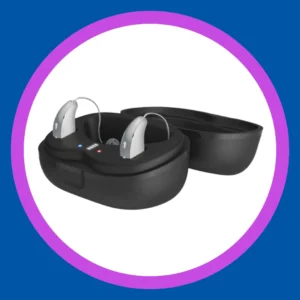
- Starkey Omega AI and Edge AI reach up to 51 hours, with a quick charge of 15 to 30 minutes
Read those as two different numbers. All of them cover a normal day. The gap only shows up on the night you forget, or the week you travel, which is why we ask about your routine rather than quoting the headline figure.
Trend Four: Sensors, and Where We Are Cautious
Starkey has put motion and activity sensors in hearing aids longer than anyone, and its current devices track activity through onboard sensors. Anyone already counting steps tends to like it. Patients who do not will ignore it entirely, and that is fine too.
Where we are careful: a hearing aid is a hearing device first. We will not recommend one for its sensors over one that fits your loss better, and we do not present activity data as clinical measurement. If a health feature is the reason you want a particular device, tell us, and we will be straight with you about what it does.
What Hearing Aid Technology Trends Never Touch
This is the part the coverage skips, and it is the part that decides your outcome.
- A fitting is measured, not predicted. Software estimates what a device does in an average ear. We use live speech mapping to measure what it does in yours
- Acclimatization takes weeks. Most people notice a difference right away, and the brain keeps adjusting for a month or more
- The coupling matters more than the chip. A wrong dome or a loose mold undoes a great device
- Follow-up is the treatment. The first setting is rarely the final one, on any platform
- Your audiogram narrows the field before preference enters. Half the devices in a roundup may not suit your loss at all
Only about one in five people who would benefit from a hearing aid wears one, according to the National Institute on Deafness and Other Communication Disorders. That number has not moved much through several generations of chips, which tells you where the real bottleneck sits.
Which Hearing Aid Technology Trends Are Worth Paying For
Match the trend to your life rather than to the marketing.
| If your hardest listening is | The trend that helps | Where it shows up |
|---|---|---|
| Restaurants and crowds | A second chip for noise | Phonak Audeo EON Sphere 90 and 70, ReSound Sensia 9 and 7 |
| Phone calls and video calls | Hands-free calling in both ears | Every current platform we fit |
| Television | Direct streaming or an accessory | Starkey streams direct, ReSound Sensia uses an accessory |
| Theaters, church, airports | Auracast | Every current platform, where the venue supports it |
| Long days and forgotten chargers | Extended battery | Starkey Omega AI and Edge AI at up to 51 hours |
| Meetings and lecture halls | A remote microphone | Phonak, with RogerDirect and no extra receiver |
Where the Brands Sit on These Hearing Aid Technology Trends
We carry five premium hearing aid brands and recommend based on your hearing, your lifestyle, and the places you most want to hear well.
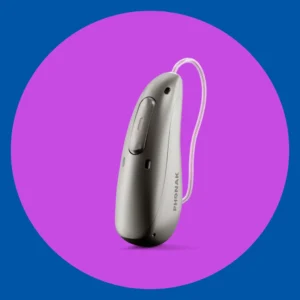
- Phonak. The EON platform in 90 and 70 tiers, with Sphere carrying the second chip and R running ERA alone. Audeo Sphere Infinio, Audeo R Infinio and Audeo Lumity all remain available. See our Phonak hearing aids page
- ReSound. Sensia in 9 and 7 tiers, with Vivia and Nexia still fitted and Vivia still the longest running of the three
- Starkey. Omega AI on the G3 platform and Edge AI on G2, both strong on endurance and both carrying health sensing
- Unitron. Shares engineering with Phonak and suits patients wanting current processing at a gentler tier
- Oticon. A limited, by-order offering here rather than a stocked brand, and rarely requested locally
How to Read a Hearing Aid Announcement
Four questions cut through a launch page quickly, whichever of the hearing aid technology trends it is selling.
- Does this change what I hear, or what I read about? A new chip that improves speech in noise changes your evening. A new colour does not
- Is the figure a maximum or a typical? Battery claims in particular carry both, and the lower one is your real day
- Does the feature need something else to work? Auracast needs a venue. A remote microphone needs someone to wear it
- Does it suit my loss? A flagship rated mild to severe is not a profound-loss device however good the processing is
Bring the announcement to your appointment. We will tell you plainly whether it applies to you, including when the answer is that it does not.
Why Choose Stanford Hearing
We are locally owned, with 20-plus years of trusted care in Sioux Falls and Buffalo, and voted Sioux Falls Local Best 20 years. Watching hearing aid technology trends is part of our job so it does not have to be part of yours.
- Free consultations with no pressure to buy
- A 10-day trial so you can wear your hearing aids in real life before you decide, and if they are not right, return them within the 10 days for a full refund
- A price match guarantee, so you will not overpay locally. If a nearby clinic beats our price on a comparable device, we meet it
- 12 months no-interest financing, subject to credit approval
- In-network with all major insurance providers, including Medicare Advantage, with benefit verification before you arrive
- Sioux Falls and Buffalo clinics, with remote care available for small adjustments
Schedule a free consultation and we will show you what is new on your own ears, rather than describing it.
Common Questions About Hearing Aid Technology Trends
Should I wait for the next generation before buying?
There is always a next generation, and waiting costs you hearing you do not get back. Both major platforms refreshed in August 2026, so the current field is as settled as it gets. Stanford Hearing will tell you if something imminent would change your decision.
Do AI hearing aids hear better in noise?
The dual chip platforms do measurably better work on speech in noise than single chip designs, and the gain is real rather than cosmetic. No device removes background noise. Come in and hear the difference in our fitting room rather than taking anyone’s word for it.
Is Auracast worth choosing a hearing aid for?
Only if the places you go have it. Every current platform Stanford Hearing fits is Auracast capable, so it rarely needs to drive the decision on its own.
Are my three-year-old hearing aids obsolete?
Almost certainly not. If they are programmed to your current hearing and still comfortable, they are doing their job. Bring them in for a check and a clean, and we will tell you plainly whether an upgrade would change your day. Sometimes the answer is a new receiver and a fresh program rather than a new device, and we would rather say so than sell you something.
Which hearing aid technology trends matter most for older adults?
Battery life, easy handling, and automatic adjustment, in that order for most of the patients we see in Sioux Falls. Sophisticated noise processing matters enormously for people who eat out often and much less for people who do not.
Does newer technology cost more?
Newer platforms typically launch at the top of the range and older generations become better value, which is why Stanford Hearing keeps fitting them. We will show you both and let you decide with the numbers in front of you.