Choosing the Best Hearing Aids for Severe Hearing Loss
Updated June 2026
Finding the best hearing aids for severe hearing loss comes down to power and precision. At this level, volume alone is not enough. You need real amplification, tight feedback control, and an expert fitting. The best hearing aids for severe hearing loss pair strong output with clear, comfortable sound.
This guide explains what severe loss means and which powerful devices help. It also covers the features that matter and how we fit them locally. Start by exploring our hearing aid options to see the brands we carry. The right device plus the right fitting changes everything.
What Severe and Profound Hearing Loss Really Means
Severe to profound loss is the most intense level of hearing loss. Your hearing thresholds begin at 70 decibels or higher. Everyday sounds like conversation or a vacuum may seem muffled or silent. Most people at this level cannot follow speech without amplification. Here are common signs of severe hearing loss:
- Speech sounds muffled even in quiet rooms
- You rely heavily on lip reading or captions
- You miss most of a group conversation
- The television is far too loud for others
- Phone calls feel impossible without a speaker
Severe loss can stem from noise, aging, illness, or genetics. It may build slowly or arrive suddenly. Sudden loss in one ear needs prompt medical care, so do not wait. A full hearing test confirms the exact degree and pattern of loss. We measure both volume thresholds and word recognition. Those two scores together shape the plan. That audiogram is the map every good fitting follows.
Severe loss also raises the daily effort of listening. That strain can wear on focus, mood, and safety over time. Treating it early tends to make communication far easier. Two aids usually help more than one when both ears have loss.
Why Behind-the-Ear Aids Are the Standard for Severe Loss
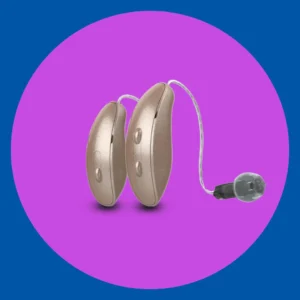
Powerful hearing loss calls for a powerful form factor. Behind-the-ear devices are the gold standard at this level. They house larger receivers and batteries that smaller styles cannot. Paired with a custom earmold, they seal amplified sound where it belongs. This table shows how style tends to track with severity:
| Degree of Loss | Common Style | Notes |
|---|---|---|
| Moderate to severe | Power RIC or BTE | Closed fit for stronger low-frequency gain |
| Severe | BTE with custom earmold | Standard for reliable, high output |
| Profound | Super-power BTE | Maximum amplification and feedback control |
A custom earmold does more than fit well. It stops high-gain sound from leaking out and howling back. Power domes can work for some severe fittings too. Still, a molded fit usually seals best at high gain. Tiny in-canal styles rarely deliver enough power here. Behind-the-ear aids also fit a wide range of ears. That makes them dependable as hearing changes.
The NIDCD notes that behind-the-ear aids suit nearly all degrees of loss. That flexibility is why they anchor severe and profound care. Your candidacy still starts with comprehensive hearing tests to map your exact thresholds. From there, we match the power to your needs.
Features That Matter Most for Severe Hearing Loss
Not every premium feature helps at this level. Some matter far more than others. The best hearing aids for severe hearing loss get the fundamentals right first. Here is what to weigh before anything else:
| Feature | Why It Matters |
|---|---|
| High gain and headroom | Delivers enough power without distortion |
| Feedback management | Stops whistling at high volume |
| Custom earmold | Seals sound in for strong amplification |
| Battery capacity | Powers long days or heavy streaming |
| Tinnitus programs | Eases ringing that often joins hearing loss |
| Durability and IP rating | Survives moisture, dust, and daily wear |
Connectivity deserves a mention too. Bluetooth streaming sends calls and audio straight to your ears. That direct signal often beats trying to hear a speaker across a room. Rechargeable batteries add convenience, though some power users still prefer size 13 or 675 cells.
Two advanced tools earn their keep for the deepest losses. Frequency lowering shifts sounds you cannot hear into a range you can. Strong speech enhancement lifts voices out of steady background noise. Remote care also lets us fine-tune many devices between visits. Handling matters as well for many patients. Larger devices with simple buttons are easier to adjust. Match the feature set to your daily life, not to a spec sheet.
The Power Models We Fit at Stanford Hearing
We carry premium brands with proven power options for severe loss. Each one earns its place for a different kind of patient. Here are the models we most often fit at this level:
| Model | Style | Best For |
|---|---|---|
| Phonak Audeo Infinio Ultra Sphere | RIC, mild to profound | Speech in noise, all-day rechargeable wear |
| Oticon Intent (BTE) | Behind-the-ear | Brain-first processing, broader power range |
| Unitron Vivante Stride V-SP | Super-power BTE | Profound loss and maximum gain |
| ReSound Nexia (BTE) | Behind-the-ear | Severe loss with tinnitus, Auracast streaming |
The Phonak Audeo Infinio Ultra Sphere reaches from mild all the way to profound. Its DEEPSONIC chip drives strong speech clarity in noisy rooms. It runs on a rechargeable battery rated for long, full days. Explore the range on our Phonak hearing aids page.
The Oticon Intent adds a behind-the-ear style that widens its power range. Its brain-first approach keeps the full sound scene available. The behind-the-ear build fits stronger prescriptions than a standard receiver style. For profound loss, the Unitron Vivante Stride V-SP is a true super-power workhorse. It also brings FLEX programs that let you try before you upgrade. Read more on our Unitron hearing aids page.
The ReSound Nexia offers a behind-the-ear build with Auracast streaming. It is a strong pick when tinnitus rides along with the loss. See the lineup on our ReSound hearing aids page. We also fit Starkey Edge AI and Omega AI. Both suit patients who value health tracking alongside real power. Their long battery life and wellness sensors appeal to active users.

How We Match a Model to Your Hearing
No single device is right for everyone with severe loss. The best fit depends on you, not on a ranking. We weigh your audiogram alongside your daily life. These factors guide our recommendation:
- Your degree of loss and word recognition scores
- How much you stream calls, music, or television
- Whether tinnitus rides along with your loss
- Your dexterity and comfort handling small parts
- Your budget and preferred technology level
A busy socializer may lean toward top speech-in-noise processing. Quieter routines may favor battery life and simple controls. We explain each trade-off in plain language. Choosing the best hearing aids for severe hearing loss is a shared decision. We guide, and you decide together. The goal is a match you will actually wear all day, every day.
Signs It Is Time for More Powerful Hearing Aids
Some patients come to us with aids that no longer keep up. Hearing can change, and gentle devices may fall short. Watch for these signs you may need more power:
- Your current aids are turned all the way up
- Speech still sounds muffled even with them in
- You hear whistling as you push the volume higher
- Group settings and phone calls remain a struggle
- Your last hearing test showed a bigger drop
If any of these sound familiar, a fresh evaluation helps. The best hearing aids for severe hearing loss can win back lost ground. We will compare your current fit against stronger options. Sometimes a new earmold and more gain make all the difference.
Why the Fitting Matters More Than the Model
A powerful device is only as good as its fitting. This is where severe loss demands real expertise. High-gain settings sit close to the edge of feedback. Get the verification wrong and the aid howls or under-amplifies. We use real-ear measurement to confirm the sound reaching your eardrum. Here is what a careful power fitting involves:
- Measuring your exact thresholds across every pitch
- Building a custom earmold for a tight, comfortable seal
- Verifying real-ear output against your prescription
- Fine-tuning feedback control at your daily volume
- Rechecking the fit over several follow-up visits
Honesty matters here too. As the Mayo Clinic advises, pick a device whose power you can raise later. No hearing aid restores every sound or erases all noise.
Adjusting to strong amplification is a process, not a switch. Your brain needs time to relearn sounds it has missed. We often raise the power gradually over a few weeks. That steady approach builds comfort and long-term success. Feedback control at high gain is a real skill. We tune it to your ears, not to an average.
What to Expect at Your Severe Loss Fitting in Sioux Falls or Buffalo
Local, hands-on care is not a luxury for severe loss. It is what makes powerful devices actually work. We take the time smaller sellers and online shops cannot. Your visit with us usually flows like this:
- A full hearing evaluation and a clear look at your results
- An honest talk about realistic goals and options
- A custom earmold impression for the best possible seal
- A verified fitting with real-ear measurement
- Follow-up tuning as your brain adjusts to sound
Adjusting to strong amplification takes patience and support. We stay with you through every step of the way. That ongoing relationship is the heart of in-person care. We schedule enough time so nothing feels rushed. Severe fittings deserve careful, unhurried attention. Visit our Sioux Falls hearing center or our Buffalo hearing center to begin. Help is always close to home.
Getting the Most From Powerful Hearing Aids
The best hearing aids for severe hearing loss reward a little daily care. Strong devices work hard, so upkeep keeps them reliable. A few habits protect your investment:
- Wipe earmolds and vents clean every day
- Store devices dry and away from heat
- Replace domes or wax guards on schedule
- Charge fully or keep spare batteries handy
- Book regular checkups to refresh the settings
Accessories can stretch performance in the hardest settings. A remote microphone sends a distant voice straight to your ears. The TV streamer does the same for shows and movies. Simple communication habits help as well. Face the speaker, reduce background noise, and ask for a rephrase when needed. Cared for well, the best hearing aids for severe hearing loss last for years. Pairing the right tools with a solid fitting is what real relief looks like.
Paying for Powerful Hearing Aids
Cost should never stand between you and hearing. Powerful devices are an investment, and we help you manage it. We work to verify your benefits before you decide anything. Here is how we ease the financial side:
- In-network with many plans, including Medicare Advantage
- Benefit verification handled by our team, not you
- No-interest financing to spread out the cost
- A price match guarantee for comparison shoppers
- Options across every budget and technology level
Insurance coverage varies, so a benefit check is always worth it. Our guide to Medicare hearing aid coverage explains one common path. Financing can turn a large cost into a simple monthly plan. Every plan is different, so we check yours directly. We will walk you through what your specific plan allows.
Why Choose Stanford Hearing for Severe Hearing Loss Care
Severe loss deserves a partner, not a sales counter. Ready to hear better with confidence? Talk with a hearing care provider who listens. For more than 20 years, our locally owned practice has served Sioux Falls and Buffalo. We fit powerful hearing aids with patience and precision. Here is what you get when you choose us:
- A free consultation to assess your hearing and your goals
- A 10-day trial so you can feel the difference first
- Five premium brands, matched to your needs rather than one label
- A price match guarantee for comparison shoppers
- No-interest financing to keep cost from standing in the way
- In-network insurance, including Medicare Advantage, with benefit verification help
- Two convenient locations in Sioux Falls and Buffalo
You do not need to sort this out alone. Schedule a free consultation and we will build a plan that fits your life.
About the Author
Dr. Jade Husby, Au.D. is the Owner and President of Stanford Hearing. She earned her Doctor of Audiology from the University of South Dakota. Her training included a residency in ear, nose, and throat care. For years she has fit powerful hearing aids for patients across Sioux Falls and Buffalo. You can meet Dr. Husby and our team and see how we approach care.
Common Questions About the Best Hearing Aids for Severe Hearing Loss
Can Hearing Aids Really Help Profound Hearing Loss?
Yes, in most cases. Super-power behind-the-ear devices deliver enough gain for profound loss. The key is a verified fitting with a proper earmold. Stanford Hearing confirms the output with real-ear measurement.
Are Rechargeable Aids Powerful Enough for Severe Loss?
Often, yes. Many modern power models now offer strong rechargeable batteries. Some heavy users still prefer larger disposable cells. Stanford Hearing helps you weigh runtime against convenience.
Why Do My Powerful Hearing Aids Whistle?
Whistling usually means sound is leaking and feeding back. A poor earmold seal is the most common cause. Refitting with a proper seal almost always solves it. Stanford Hearing checks the seal and feedback settings closely.
Will Insurance Cover the Best Hearing Aids for Severe Hearing Loss?
It depends on your plan and benefits. Many plans, including Medicare Advantage, offer some coverage. We verify your benefits before you commit to anything. Stanford Hearing handles that check so there are no surprises.
How Long Do Powerful Hearing Aids Last?
Most hearing aids last around five years with good care. Higher-gain use can wear parts a little faster. Regular cleaning and checkups extend their life. Stanford Hearing services and maintains every device we fit.
Can I Try the Best Hearing Aids for Severe Hearing Loss First?
Yes, and we encourage it. You can wear your devices on our 10-day trial. Real life is the true test of any fitting. Stanford Hearing offers this at both Sioux Falls and Buffalo.