
Comparing the ReSound Vivia and the Starkey Edge AI
Updated September 2026 · Dr. Jade Husby, Au.D.
Short Version
ReSound Vivia vs Starkey Edge AI splits along size and stamina. Vivia is the smaller device with a receiver option that uses your own ear shape. Edge AI runs roughly twice as long per charge and adds health tracking. Both are still fitted here, and both now have a newer sibling.
These two come up together at appointments because they landed in the same window and they aim at the same person: someone who wants modern noise processing without a device announcing itself from across the room. ReSound Vivia vs Starkey Edge AI is worth sorting out properly, since the two differ in ways a spec sheet flattens. One is built around discretion and how sound reaches your ear. The other is built around endurance and what it can measure while you wear it. Both sit inside our hearing aid options, and we fit both in Sioux Falls and Buffalo.
Where ReSound Vivia vs Starkey Edge AI Splits
Skip the marketing and the difference is easy to name.
- Vivia is the smaller housing, a microRIE, and it is rated discreet where Edge AI is rated a standard receiver-in-canal size
- Edge AI runs up to 51 hours per charge against Vivia’s 30, which is not a small gap
- Edge AI carries health and activity tracking. Vivia does not, and does not pretend to
- Vivia offers the M and RIE receiver option, which places a microphone inside your ear so your own ear shape helps locate sound
- Vivia is rated for mild to profound loss, Edge AI for mild to severe
Fitting range matters more than the rest for some patients. If your loss sits at the deeper end, that line narrows the choice before preference ever enters the conversation.
Inside the ReSound Vivia
Vivia arrived as ReSound’s smallest AI-driven receiver-in-canal device, and the engineering went into two places: size and spatial hearing. We cover the wider ReSound range separately.
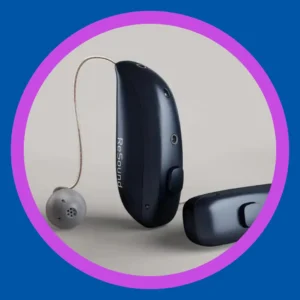
What Vivia does well
- A microRIE housing that most people cannot see on someone else’s ear
- The M and RIE receiver option, which uses the shape of your outer ear to help your brain place where sound came from
- Intelligent Focus, which narrows the listening beam when a room turns difficult
- Autoscope Adaptive Directionality and DFS Ultra III feedback control, with a music mode
- Auracast and Bluetooth LE Audio streaming, with two connections at once
- Remote fine tuning through ReSound Assist Live, so a small adjustment does not always mean a drive
- An IP68 rating and 360 degree directionality
Vivia gives you 17 fine-tuning channels and up to 30 hours on a charge, with 24 to 36 hours typical depending on how much you stream. Tinnitus sound support is included. There is no telecoil.
Where Vivia asks something of you
Thirty hours is a full day and change, and it still means charging nightly. The smaller housing is also a smaller battery, which is the trade you make for discretion. If dexterity is a concern, hold one before you commit, because small devices are harder to handle.
Inside the Starkey Edge AI
Edge AI runs Starkey’s G2 Neuro Processor and takes the opposite approach. It is a device built to be worn hard and forgotten.
What Edge AI does well
- Up to 51 hours per charge, with 36 to 56 hours typical, plus a quick charge of 15 to 30 minutes
- Edge Mode, a tap that reprocesses a difficult listening moment on demand
- Health and activity tracking through sensors in the device
- Own voice processing, which stops your own speech booming in your head
- Direct television streaming with no accessory in between
- Twenty-four fine-tuning channels, the wider adjustment range of the two
- An IP68 rating and 360 degree directionality
Edge AI is rated mild to severe, includes tinnitus sound support, and has no telecoil.
Where Edge AI asks something of you
It is the larger of the two, though not large. And Edge Mode is a manual feature, which suits people who like a control and frustrates people who wanted the device to handle it.
Side by Side
| Feature | ReSound Vivia 9 | Starkey Edge AI 24 |
|---|---|---|
| Style | microRIE, high discretion | Receiver-in-canal |
| Battery per charge | Up to 30 hours | Up to 51 hours |
| Typical range | 24 to 36 hours | 36 to 56 hours |
| Fine-tuning channels | 17 | 24 |
| Fitting range | Mild to profound | Mild to severe |
| Health tracking | No | Yes |
| Television sound | Streaming through the platform | Direct from the TV |
| Noise control style | Intelligent Focus, automatic beam narrowing | Edge Mode, tap to reprocess |
| Water and dust | IP68 | IP68 |
| Telecoil | No | No |
Noise: The Test That Decides It
A quiet living room flatters every hearing aid. A crowded room does not, and that is where ReSound Vivia vs Starkey Edge AI stops being a specification argument.
ReSound built Vivia to decide for itself. Intelligent Focus narrows the listening beam toward speech when the room gets loud, and the M and RIE receiver, where you choose it, keeps some of the natural direction cues your outer ear provides. The result suits people who want the device managing itself.
Starkey went the other way. The Edge AI processor handles the room, and when that is not enough you tap for Edge Mode and it takes a fresh read. Edge AI suits people who want a lever.
Neither device removes background noise. Both reduce it so speech is easier to follow, and how much easier depends on your loss, your ears, and the fitting far more than on the badge.
Streaming, Phones, and Auracast
On connectivity, ReSound Vivia vs Starkey Edge AI is close to a tie. Both are Auracast ready and both hold two connections at once, so a phone and a tablet can stay paired.
- Both take calls hands free, with the microphones in the hearing aids picking up your voice
- Both work with Apple and Android devices
- Edge AI streams television sound directly, which removes a box from your setup
- Auracast matters where your venues have it, so its value is local rather than universal
Bring your own phone to the appointment. We pair it in the room, which settles the question faster than any compatibility chart.
Tinnitus Support on Both
Both devices include tinnitus sound support. There is no cure for tinnitus, and there are real ways to manage it and reduce how much it intrudes. The clinical practice guideline from the American Academy of Otolaryngology separates bothersome tinnitus from the kind that does not disrupt a life, and it points at sound therapy and counselling rather than a fix. Where hearing loss and tinnitus arrive together, which is the common pattern, a well fitted hearing aid does double duty. Our tinnitus treatment options page covers the rest.
What Changed in August 2026
Both brands launched successors, and both of the devices in this ReSound Vivia vs Starkey Edge AI comparison remain available and fitted.
- ReSound Sensia is the newer ReSound platform, in tiers 9 and 7, running a dual chip design with a neural denoiser and reaching up to 24 hours per charge
- Starkey Omega AI runs the newer G3 platform and matches Edge AI on battery while adding refinements
Newer is not automatically better for you. Vivia’s 30 hours beats Sensia’s 24, and Vivia reaches profound loss where Sensia is rated mild to severe. Edge AI and Omega AI sit close enough that budget often decides. This is exactly why we do not lead with whatever launched most recently.
Fit, Handling, and the Parts People Forget
Two devices can score the same on paper and feel completely different by week three. What separates them is rarely processing.

- The charger. One of these lives on your nightstand and travels in your bag. Handle both cases before you decide, since a lid that fights you at bedtime becomes a reason not to wear the aids at all
- Dexterity. A smaller housing is harder to grip. If arthritis or neuropathy is part of your life, say so at the appointment and we will factor it in rather than treating size as a pure win
- The app. You will open it more than you expect. ReSound Smart Fit and the My Starkey app both allow home adjustment, and they look and behave differently. Try both on your own phone
- Domes and molds. Comfort comes from the coupling more than the device body. A device you love with the wrong dome is a device you stop wearing
- Wax and moisture. Both carry an IP68 rating, and both still need cleaning. South Dakota winters and humid summers are hard on receivers either way
None of this appears in a comparison table, and all of it decides whether a hearing aid is still in your ear a year from now. Our hearing aid repair and maintenance service exists because devices live in ears rather than in drawers, and we would rather see you for a cleaning than have you give up on a device that needed one.
What the Fitting Decides
Whichever way you go, the appointment does more for your hearing than the model choice does. We measure your loss, program to it, then verify the result inside your ear canal rather than trusting the software’s prediction of an average ear. Yours is not average. Then we adjust, because the first setting is almost never the final one and your brain keeps adapting for weeks.
Best If You
There is no single best hearing aid, only the one that is best for you. Here is how ReSound Vivia vs Starkey Edge AI tends to resolve at the appointment.
- Best if discretion is your first requirement: Vivia, the smaller of the two by a clear margin
- Best if you want natural direction cues: Vivia with the M and RIE receiver
- Best if your loss is at the profound end: Vivia, rated mild to profound where Edge AI stops at severe
- Best if charging is the thing you forget: Edge AI, at up to 51 hours
- Best if you already track your activity: Edge AI, with sensors on board
- Best if you want a manual control for hard rooms: Edge AI and its Edge Mode tap
- Best if television is most of your listening: Edge AI, streaming direct
Only about one in five people who would benefit from a hearing aid wears one, according to the National Institute on Deafness and Other Communication Disorders. Choosing between two good devices is a better problem than the one most people are stuck with.
Why Choose Stanford Hearing, and What Happens Next
We are locally owned, with 20-plus years of trusted care in Sioux Falls and Buffalo, and voted Sioux Falls Local Best 20 years. We carry five premium hearing aid brands and recommend based on your hearing, your lifestyle, and the places you most want to hear well. Settling ReSound Vivia vs Starkey Edge AI with us costs you nothing and commits you to nothing.
- Free consultations with no pressure to buy
- A 10-day trial so you can wear your hearing aids in real life before you decide, and if they are not right, return them within the 10 days for a full refund
- A price match guarantee, so you will not overpay locally. If a nearby clinic beats our price on a comparable device, we meet it
- 12 months no-interest financing, subject to credit approval
- In-network with all major insurance providers, including Medicare Advantage, with benefit verification before you arrive
- Sioux Falls and Buffalo clinics, with the same team handling every follow-up
Schedule a free consultation and we will test your hearing, put both devices on your ears, and use live speech mapping to verify what each one does inside your ear canal rather than what the software predicts.
Common Questions About ReSound Vivia vs Starkey Edge AI
In ReSound Vivia vs Starkey Edge AI, which is smaller on the ear?
Vivia. It uses ReSound’s microRIE housing and is rated for high discretion, while Edge AI sits in a standard receiver-in-canal size. Both disappear under hair. At Stanford Hearing we put both on your ears with a mirror in your hand before you decide anything.
Which lasts longer on a charge?
Edge AI, by a wide margin. It reaches up to 51 hours with 36 to 56 typical, against up to 30 hours for Vivia with 24 to 36 typical. Both need a nightly charge in practice, and Edge AI forgives a missed one.
Are these still current, or should I wait for the newer models?
Both are current and both are fitted at Stanford Hearing today. ReSound Sensia and Starkey Omega AI launched in August 2026, and neither makes Vivia or Edge AI obsolete. Vivia still runs longer than Sensia and reaches a deeper loss, which is a fair reason to choose it on purpose.
Do either of them have a telecoil?
Neither Vivia 9 nor Edge AI 24 includes a telecoil. If you rely on looped venues, tell us at your appointment, because that requirement narrows the field and Stanford Hearing carries options that address it.
Which one is better for tinnitus?
Both include tinnitus sound support, and neither cures tinnitus. What decides the outcome is a device programmed to your hearing loss and a plan you can live with, which our team in Sioux Falls and Buffalo builds with you in the same appointment.
Can I try both?
Yes. Every purchase from Stanford Hearing includes a 10-day trial so you can wear your hearing aids at home, at work, and out with people before you decide. If they are not right for you, return them within the 10 days for a full refund.